
SAP Enterprise Support: Benefits, Scope, Cost & Value Explained

SAP Enterprise Support: Benefits, Scope, Cost & Value Explained

SAP Support

Published: May 22, 2026

Banner

SAP Enterprise Support is SAP’s top support tier. On cloud, it’s baked into every subscription at no extra charge. On-premise, it sits a rung above Standard Support and runs about 22% of your net license value a year. And it buys a lot more than break-fix: continuous innovation, mission-critical response times, expert-led sessions, quality checks against your live system, and a full learning academy. Put bluntly, Standard Support keeps the lights on. Enterprise Support helps you get your money’s worth.

Most people land here with one of three questions. What’s really in it? What does it cost, and is that cost fair? And how does it hold up against the alternatives, be that Standard Support or going third-party? This guide takes all three on, then gets practical about wringing real value from an entitlement you’re very likely already paying for.

What is SAP Enterprise Support?

Strip it back and SAP Enterprise Support is the safety net and the toolkit sitting under your SAP systems. It handles the obvious stuff, incident handling, software corrections, security patches, the legal and regulatory updates. But it reaches past that too, into proactive services meant to keep your landscape healthy and pointed at whatever SAP shipped most recently.

The bit that trips people up is cloud versus on-premise, so let’s sort that one out first.

Who gets it and how it’s included

Run SAP in the cloud and Enterprise Support is already yours, folded into the subscription. There’s no separate line item to hunt for; it comes as part of the package, bundled into what SAP now labels the Foundational Success Plan. Every cloud customer has it, whether they ever touch it or not.

On-premise plays out differently. There it’s a paid tier, and it’s the one most of the larger SAP shops end up on. You pay an annual maintenance fee worked out as a percentage of your license value, and in exchange you get the whole scope. Smaller outfits sometimes stick with Standard Support, which is lighter and cheaper. We’ll get to that gap shortly.

Where it sits in SAP’s support portfolio

SAP’s support world stacks up in layers, and the names shift often enough to keep everyone slightly confused. At the bottom sits basic maintenance. Above it, Standard and Enterprise Support are the two everyday tiers most customers choose between. Higher still are the premium engagements, the likes of SAP Preferred Success and assorted paid advisory and managed offerings, for anyone who wants a closer, more hands-on relationship.

Enterprise Support is the workhorse in the middle of all that. Wide enough to cover almost everything a live SAP landscape throws at it, without crossing into the bespoke premium territory that comes with a bespoke price tag.

What’s included in SAP Enterprise Support? (Scope)

This is where the offering earns its keep. On paper the scope is broad, yet most customers use only a sliver of it, which is a pity given they’re paying for the whole thing. The pieces that matter most are below.

Continuous improvement and innovation

This is the pillar that sets Enterprise Support apart from plain maintenance. You get access to new software releases, enhancement packages, and feature packs, plus the tools and procedures to put them in. The point is that your investment doesn’t sit still. As SAP ships new capability, including the AI features now landing across SAP S/4HANA and the wider portfolio, this is the channel that lets you take it on.

Mission-critical support and SLAs

When something business-critical goes down, this is the part you’re leaning on. Enterprise Support comes with defined service level agreements for response times on high-priority incidents, and a mission-critical process built for the moments when a core system is dark and money is walking out the door. The response commitments run tighter than Standard Support, and for plenty of customers that alone is the clearest reason to pay up.

The global support backbone

Behind all of it sits SAP’s global support machine. Knowledge bases, a catalogue of documented issues and their fixes, the tooling to apply corrections, and incident handling that runs around the clock across regions. In plain terms, this is what means that when you hit a wall at 2am, the fix is probably already written up somewhere, and if it isn’t, there’s a global team to escalate to.

Tools, content, and Enterprise Support Academy

The Enterprise Support Academy is one of the most underused things SAP offers. It’s a library of learning material, trainings, and expert guidance, served up in all sorts of formats and depths, every bit of it already covered by what you pay. If your team is teaching itself SAP by trial and error, a good chunk of that pain simply doesn’t need to happen. The Academy, plus value maps that lay out learning paths by topic, exists for exactly this.

Guided self-services and Continuous Quality Checks (CQCs)

Two services deserve a name-check, because the value they return is out of all proportion to what they cost you, which is nothing extra. Continuous Quality Checks put SAP experts onto your live system, working from your real data, to pull it apart and hand back a report with findings and a plan of action. Think of it as a health check run by people who see hundreds of SAP landscapes every year. Expert-Guided Implementations, or EGIs, are the other one: multi-day remote workshops where SAP engineers walk your team through finishing a specific task. You learn by doing it for real, with a net under you.

Both come included. Both go unclaimed by most customers.

Key benefits of SAP Enterprise Support

Strip away the service names and the value boils down to a handful of things that move the needle for a business running SAP. Your systems stay stable and current, since corrections, patches, and legal changes reach you as a matter of course. When something critical falls over, you’ve got contractual response times to lean on instead of a queue ticket. Your team can skill up through the Academy rather than the expensive way. Proactive checks flag risks while they’re still lines on a chart, not incidents. And the door to SAP’s newest capability, the wave of AI features included, stays open, so the platform you bought keeps growing instead of aging in place.

None of that is glamorous. All of it compounds. The customers who get the most from Enterprise Support treat it as a live entitlement to be worked, not an insurance policy to file and forget.

How much does SAP Enterprise Support cost?

This is the question the marketing pages tend to tiptoe around, so let’s be blunt.

The 22% fee explained

For on-premise SAP software, Enterprise Support runs at roughly 22% of your net license value, billed once a year. Standard Support, the tier underneath, usually sits nearer 19%. So the premium for Enterprise works out to about three percentage points of your license value a year, in return for the wider scope, the tighter SLAs, and the proactive services covered above.

On cloud the calculus is different, remember. Enterprise Support is part of the subscription, so there’s no separate fee to weigh. The cost question really only bites for on-premise and hybrid customers.

One thing to plan around: maintenance fees aren’t frozen for good. Customers who sit on older platforms past SAP’s mainstream maintenance deadlines can watch costs creep up, and extended-maintenance deals can nudge the effective rate higher still. If you’re on ECC and squinting at the 2027 mainstream maintenance horizon, a planned SAP S/4HANA migration belongs in the cost conversation, not in a footnote to it.

Is it worth it?

It depends on how much of the scope you use. That’s the uncomfortable truth sitting behind the fee.

If Enterprise Support means, to you, “the number we ring when something breaks,” then yes, you’re paying premium rates for a sliver of the value, and the skeptics circling the 22% have a point. But run the Continuous Quality Checks, send people through the Academy, pull in EGIs whenever you tackle something new, and take up the innovations you’ve got access to, and the arithmetic shifts hard in your favour. The fee is fixed. What you pull out of it is entirely on you.

That gap, between what customers pay for and what they use, is the single biggest reason Enterprise Support carries a mixed reputation. The offering rarely underdelivers. It’s usually the customer who under-claims.

SAP Enterprise Support vs Standard Support

The two mainstream tiers, laid side by side.

Area Standard Support Enterprise Support
Typical annual cost ~19% of license value ~22% of license value
Corrections and patches Yes Yes
Legal and regulatory updates Yes Yes
New releases and enhancement packs Yes Yes
Mission-critical support, tighter SLAs Limited Yes
Continuous Quality Checks (CQCs) No Yes
Expert-Guided Implementations (EGIs) No Yes
Enterprise Support Academy Limited Full access
Business process operations support No Yes
Best fit Smaller, stable landscapes Larger or mission-critical


Short version: Standard Support covers stability and compliance. Enterprise stacks the proactive, strategic layer on top, quicker response when it counts, quality checks, guided help, and the learning to make use of all of it. If your SAP systems are business-critical in any real sense, that three-point premium tends to pay for itself in avoided downtime alone.

SAP Enterprise Support vs third-party support

The other comparison people chew on, usually once the annual fee starts to sting, is walking away from SAP support altogether and moving to a third-party provider like Rimini Street or Spinnaker.


Factor SAP Enterprise Support Third-Party Support
Typical cost ~22% of license value ~Half of SAP’s fee
New releases & patches Full access None
Legal & regulatory updates Included Provider-dependent
Custom code support Limited Strong
Upgrade pressure On SAP’s timeline None
Path back to S/4HANA Open Back-maintenance risk
Best fit Landscapes chasing innovation Stable, customized, static


The third-party pitch is simple enough. Roughly half the cost. Nobody is pushing you to upgrade on SAP’s schedule. And support for your customizations, which SAP’s own support won’t always stretch to cover. For a stable, heavily customized landscape that isn’t chasing new features, that can be a perfectly rational move.

The trade-offs are real, though. Step away from SAP support and you give up new releases, enhancement packages, patches, and the legal and regulatory updates SAP pushes out. You’re frozen at whatever version you’re on. And when you do eventually want to move to S/4HANA, and most roadmaps end up there, coming back into SAP support can trigger back-maintenance charges that eat into what you saved. It comes down to how customized and stable your landscape really is, and how much you value staying current against pocketing the difference. A trusted SAP implementation partner can model both routes against your own landscape before you commit either way.

How to get the most value from SAP Enterprise Support

If you take one thing from this guide, make it this: the offering is only ever as good as your use of it. Here’s how the customers who see real returns go about it.

Claim your Continuous Quality Checks. They’re included, and running a CQC before a major change or a go-live catches the kind of problem that otherwise shows up in production at the worst possible moment. Book Expert-Guided Implementations when your team is doing something for the first time, a security setup, a technical upgrade, a new module, so you learn it with SAP engineers beside you rather than off a forum thread at midnight. Put people through the Enterprise Support Academy and use value maps to give the learning some shape. And treat the innovation entitlement as a mandate rather than an option, because paying for access to new capability and adopting none of it is funding a road you never drive down.

The thread running through all of it is simple. Enterprise Support rewards the active customer and quietly overcharges the passive one. Be the first kind.

How Accely helps

Most SAP support value goes unclaimed for a dull reason: nobody has the hours to work the entitlement, so it sits idle while the annual invoice gets paid anyway. That’s the gap we close. As an SAP Gold Partner with 26+ years in SAP delivery, Accely helps customers pull full value from their support investment, whether that’s running the quality checks you’re owed, building your team’s skills through structured enablement, or laying AI-assisted managed services over the top for proactive monitoring and faster fixes. We sit between you and your SAP landscape so the support you already pay for does its job. The goal isn’t more tickets. It’s fewer, caught sooner, with your people freed up for the business instead of the backlog.

Paying for SAP support you never fully use?

Accely helps you claim the quality checks, skills, and innovation you’re already paying for. Let’s turn that support budget into value you can point at.

Conclusion

SAP Enterprise Support is one of those things nearly every SAP customer pays for and relatively few use to the full. The scope is wide, the proactive services are worth having, and for mission-critical landscapes the premium over Standard Support usually earns itself back on avoided downtime alone. But the fee is fixed while the value isn’t. What you get back tracks how hard you work the entitlement.

Whether you’re weighing the cost, comparing tiers, or just clocking that you’ve been paying for services you never claimed, the move is the same: audit what you’re entitled to, then start using it. Talk to our SAP expert team and we’ll help you turn the support you already pay for into value you can see.

Frequently asked questions

What is SAP Enterprise Support? +

SAP Enterprise Support is SAP’s premium support tier. It comes free with every SAP cloud subscription, and on-premise it’s the step up from Standard Support, priced around 22% of net license value a year. It covers incident handling, corrections, legal updates, and new releases, and adds proactive services like Continuous Quality Checks, Expert-Guided Implementations, mission-critical support, and the Enterprise Support Academy.

How much does SAP Enterprise Support cost? +

On-premise, it’s priced at roughly 22% of your net license value a year, against about 19% for Standard Support. On cloud, it’s part of the subscription with no separate charge. Fees can climb for customers who stay on older platforms past SAP’s maintenance deadlines.

What is the difference between SAP Standard Support and Enterprise Support? +

Standard Support handles the essentials, corrections, security patches, legal and regulatory updates, and new releases. Enterprise Support layers a proactive, strategic tier on top: tighter mission-critical SLAs, Continuous Quality Checks, Expert-Guided Implementations, full access to the Enterprise Support Academy, and business process operations support. The price difference works out to around three percentage points of license value.

Is SAP Enterprise Support worth the 22% fee? +

That comes down entirely to how much of the scope you use. Customers who claim their quality checks, run guided implementations, train through the Academy, and take up the innovations they can reach tend to do well out of it. Treat it purely as a break-fix line and you’ll likely overpay, since most of the entitlement goes unclaimed.

What is a Continuous Quality Check (CQC)? +

A Continuous Quality Check is a service where SAP experts examine your live system using real data and hand back a report with findings and a prioritized action plan. CQCs come with Enterprise Support, and teams usually run them ahead of major changes or go-lives to catch trouble, an undersized system or a configuration clash, before it reaches production.

Can I use third-party support instead of SAP Enterprise Support? +

Yes. Providers like Rimini Street offer third-party SAP support at around half the cost, with no upgrade pressure and solid support for customizations. The catch is losing access to SAP’s new releases, patches, and legal updates, plus possible back-maintenance charges if you later return to SAP to move onto S/4HANA. It fits stable, customized landscapes that aren’t chasing new features.

Profile

Piyush Jani

Head SAP AMS

Copy link

SAP AMS Head with deep expertise in SAP managed services, global delivery, and support that drives efficiency, uptime, and value across enterprise landscapes.

7 Things to Consider Before an SAP S/4HANA Migration

7 Things to Consider Before an SAP S/4HANA Migration

SAP Support

Published: May 15, 2026

Banner

Most of what makes or breaks an SAP S/4HANA migration has little to do with the tech. It comes down to seven calls: do you have a real business case, which path fits (greenfield, brownfield, or selective), how clean is your data, what shape is your custom code in, where will it run, and can you fund the timeline you actually need? Sort those out and go-live is quiet. Skip them and every old problem tags along for the ride.

Nobody migrates to SAP S/4HANA over a long weekend. This is a bet on how your business runs for the next decade, and it has a habit of punishing anyone who treats it as a pure IT job. The teams that come out bruised? They rarely hit a technical brick wall. They waved off the hard questions early and paid for it later, chasing scope, data problems, and cost overruns the whole way through.

And there’s a deadline breathing down everyone’s neck. SAP pulls the plug on mainstream maintenance for ECC on 31 December 2027, and the nearer that gets, the tighter and costlier the market becomes. Counterintuitive as it sounds, that’s exactly why you want to take your time at the front of the project, not the back. The seven SAP S/4HANA migration considerations that follow are the ones I’d settle before signing off on a date, a partner, or a path. Would you rather not go it alone? That’s the whole point of an AI-assisted SAP S/4HANA migration.

What is an SAP S/4HANA migration?

So what does an SAP S/4HANA migration actually involve? At its core, you’re moving off an older SAP ERP (usually SAP ECC) onto SAP’s current platform, S/4HANA, and dragging your data along with you. What sets it apart from a bog-standard upgrade is the plumbing underneath. S/4HANA runs on a leaner data model and the in-memory HANA database, which means tables you’ve leaned on for years, chunks of custom code, reports people depend on every morning, a fair bit of it has to be reworked.

Which is why an SAP ECC to S/4HANA migration is a business project first and a technical one second. You’re not nudging a version number forward. You’re making calls: which processes survive, which get torn down and rebuilt, and how much of your history is worth hauling across.

Why migrate to SAP S/4HANA now?

Waiting doesn’t save you a penny here. If anything, it adds to the bill. Three forces are tightening the screws on your timeline.

SAP ECC support ends in 2027

On 31 December 2027, SAP turns off mainstream maintenance for ECC (Business Suite 7). Sure, you can buy an extension to 2030 for a fee, and a small club of really big or really complex shops can push further still through RISE with SAP. But the day mainstream support stops, so do your security patches, your legal updates, your technical fixes. Try walking into a board meeting and proposing you run finance and supply chain on an unsupported system. See how far that gets.

The cost of waiting

Imagine every ECC customer on earth shuffling toward one exit at the same moment. That’s more or less the situation. The closer 2027 gets, the harder it is to find seasoned SAP people, and the ones you do find charge more. On top of that, the Compatibility Packs (the things that let certain old ECC functions keep running inside S/4HANA) start expiring around now, so your room to move shrinks. Get in while there’s slack and you call the shots on approach. Drag your feet and you may get boxed into a rushed conversion, because it’s the only thing that squeezes into the calendar.

What you gain

Staying supported is just the price of entry. The upside runs deeper. Instead of waiting on overnight batch jobs, you get data in real time. You get the Fiori interface. You get a Clean Core setup that keeps your next upgrade from turning into a project of its own. And AI ships in the box now, Joule and SAP Business AI both, tucked right into the work your teams do all day. In practice, most of the payback only shows up once you’re running on an AI-enabled SAP S/4HANA core.

7 key SAP S/4HANA migration considerations

Seven things to settle before anyone kicks off. Treat them as decisions you owe yourself up front, not documentation to file away. Each one tugs on your cost, your timeline, and how much you squeeze out of S/4HANA down the line.

1. Define your target state and business case

First question, and it’s a blunt one: why are you doing this at all? Running a quick proof of concept, or heading straight into production? Trying to stay supported with minimal fuss, or using the disruption to finally fix processes while the hood’s already up? Whatever the answer, write it in plain words. The migrations I’ve watched go off the rails almost always started with something woolly like “let’s implement S/4HANA” and never agreed what a win looked like. Nail the business case and, funnily enough, it more or less chooses the path for you.

2. Choose your migration path

There are three ways in. Which one suits you depends on a single question: how much of what you’ve already got is worth keeping?

Greenfield

Blank slate. You stand up S/4HANA from scratch, build your processes around SAP’s standards, and wave goodbye to the old customisation. Makes sense when your current system is long in the tooth, patched to within an inch of its life, or just doesn’t match how you work anymore. Heavier lift, but the reward’s bigger too.

Brownfield

A straight conversion. You lift your existing ECC system, its config, its history, and set it down on S/4HANA more or less intact. Faster, less upheaval. The trade-off? You’ll haul the old complexity along with you unless you tidy up en route.

Selective (Hybrid)

The middle lane, sometimes called bluefield. Keep the processes and data that pull their weight; rebuild the rest. You decide what changes and what doesn’t, though it takes sharp scoping and, usually, a third-party tool to pull it off.


Path Effort / timeline Best for Watch out for
Greenfield Highest, ~18 to 36 months Outdated systems, process redesign, non-SAP sources Cost and change management
Brownfield Lower, ~9 to 18 months Well-run ECC, minimal disruption Carrying legacy debt forward
Selective / hybrid Variable, phased Large, complex landscapes Scoping precision, tooling needs


3. Check your system and data readiness

Measure first. Always. The SAP Readiness Check tells you how much is going to break. The ABAP Test Cockpit puts a number on your custom code. And somebody, ideally someone without a stake in the answer, needs to give your data an honest grade. This is the step where gut feelings turn into evidence you can plan around. A proper SAP discovery and evaluation does precisely that, and pound for pound it’s the cheapest insurance on the whole job.

4. Plan data migration and cleansing

Not every record has earned a seat on the bus. Work out early what travels, what gets archived, and what you leave at the curb. And clean it before you move it, not after, because dirty data tipped into S/4HANA just recreates yesterday’s mess on a faster kit. Want the order of play spelled out? Our rundown of the core SAP S/4HANA migration steps walks you through it.

5. Sort out custom code and integrations

Clean Core rewards standard config and side-by-side extensions, and it frowns on hacking the core itself. So haul every customisation into the dock and make it justify its existence. Does it still pull its weight, or was it a workaround for something SAP now does natively? While you’re in there, map your integrations. Migrations have a nasty habit of surfacing brittle point-to-point links that need rebuilding, not just a fresh round of testing.

6. Pick your operating model and deployment

So where does S/4HANA actually live? On-premise, private cloud, public cloud, and, increasingly, inside RISE with SAP as the wrapper around all of it. Mostly standard processes? Public cloud and its rolling updates will suit you fine. Carrying heavier customisation? You’ll likely be happier on SAP S/4HANA Private Cloud, with a steadier base to build on. Already parked on a hyperscaler? The same logic behind migrating SAP to Azure applies: pick the model that matches how much control and customisation you truly need, not whichever one has the shiniest label.

7. Plan budget, timeline, resources, and change management

Budget for the stuff that hides. Data prep alone can swallow a quarter of the effort, and it belongs to your senior people, not whoever’s got a free afternoon. Set the timeline after the readiness check hands you real numbers, never before. And whatever you do, don’t bolt training on at the end. A migration that’s spotless on paper but shunned by the people meant to use it hasn’t succeeded, it’s failed. Tell folks what’s coming early, train them by role, and give them a reason to want the switch.

Not sure which of these applies to your landscape?

Accely’s SAP specialists can pressure-test your readiness before you commit to a path or a date.

How does an SAP S/4HANA migration work?

SAP hands you a playbook for the whole thing, called SAP Activate. It runs in six phases:

  1. Nail the business case, run the readiness check, sketch out the target architecture.
  2. Stand up the environment, plan the work, get the team in a room.
  3. Fit-to-standard workshops that decide what stays standard and what has to bend.
  4. Build it, configure it, move the data, test in cycles.
  5. Cutover, go-live, hypercare.
  6. Steady the ship, then start making it better.

Discovery’s the one everyone speeds through and later kicks themselves over. It sets the tone for everything that follows.

Technical vs process-oriented implementation

Every migration breaks into two halves. The technical half, moving the database to HANA, reshaping the data model, swapping out program code, standing up Fiori, is well tooled and reasonably predictable. The other half is the messy, human one: redrawing how work flows, wiring up new processes, sorting roles, and coaxing people onto them. The upside? You can usually run the process side on its own track, apart from the technical cutover, so one never ends up holding the other hostage.

How AI is changing SAP S/4HANA migration in 2026

Rewind two years and “AI in your migration” meant a slide in the pitch deck and not much else. Not anymore. AI-assisted tooling now chews through your custom code and flags what an upgrade will snap, grades your data quality before a single record budges, and drafts test cases so QA isn’t starting from nothing. Does any of that put consultants out of a job? No. It clears the drudgery off their desks, so the experienced ones spend their hours on the judgement calls instead of grinding through analysis by hand.

And once you’ve gone live, SAP Business AI carries the same smarts into daily operations, flagging odd numbers in finance, tightening up forecasts, that sort of thing. It’s how we run delivery at Accely: AI-assisted wherever it saves time, with our people keeping a firm hand on every decision that counts.

Common SAP S/4HANA migration challenges

Most migrations stumble over the same short list. Spot them early and you’ve won half the fight.

  • Dirty data. Duplicates, dead records, entries that contradict each other. It slows the move and poisons the new system. Scrub it first.
  • Custom code nobody claims. Years of ABAP written by people are long gone. Get the ATC on it early, not when you’re neck-deep in testing.
  • The skills crunch. As 2027 looms, decent SAP hands get scarce. Book your team well ahead.
  • People digging in. New screens, new roles, new habits are a lot to ask of anyone. Bring users along early, or watch adoption stall.
  • Scope creep. “While we’re in here…” is exactly how a timeline doubles when nobody’s watching. Agree the scope, then defend it.

Benefits of migrating to SAP S/4HANA

Handle it well and here’s what lands on your side of the ledger:

  • Reporting in real time, not whenever last night’s batch decides to finish.
  • A tidier, role-based experience courtesy of SAP Fiori.
  • A Clean Core, so the next upgrade stays cheap and quick instead of turning into another epic.
  • AI baked right in, Joule and SAP Business AI both, sitting inside the day-to-day.
  • A lighter data footprint and fewer systems to babysit, which quietly drags your total cost of ownership down.
  • Cloud headroom to scale without ripping out and rebuilding your infrastructure.

Planning your move to S/4HANA?

Talk to Accely’s SAP specialists and get a straight, evidence-based read on where you stand.

How Accely approaches your SAP S/4HANA migration

Accely’s an SAP Gold Partner with 23+ years buried in enterprise SAP and 950+ organisations served across the map. We run migrations the way this piece says to plan them: readiness first, the path picked on evidence rather than a hunch, and the data work put in senior hands. Our SAP S/4HANA data migration approach uses AI to speed up the assessment, the code remediation, and the testing, while our consultants stay on the hook for the decisions and the outcome.

Conclusion

An SAP S/4HANA migration rewards the teams that do their thinking before they jump. Sort out the business case, choose the path of evidence, scrub the data, plan for the people who’ll live with it, and the technical cutover barely registers. The 2027 deadline is real enough. But panic isn’t the response to it. Preparation is.

Start with a readiness conversation. It’s the cheapest, most useful thing you can do on this entire list.

Frequently asked questions

How long does an SAP S/4HANA migration take? +

Depends how tangled your setup is and which path you take. Brownfield conversions tend to land in the 9-to-18-month range. Greenfield rebuilds usually stretch to somewhere between 18 and 36. What moves the needle most isn’t the method, it’s your data volume, the state of your custom code, and how many systems you’re trying to fold into one.

How much does an SAP S/4HANA migration cost? +

No price tag on the shelf, I’m afraid. It rides on scope, how healthy your data is, your custom code, and the approach. Greenfield usually costs more than brownfield, since you’re redesigning rather than converting. The only figure worth trusting comes out of a readiness assessment, not a number scribbled on a napkin.

Greenfield or brownfield, which should we choose? +

Brownfield if your ECC system’s in decent nick and you want the quicker, lower-risk hop. Greenfield if your processes are dated and you want a clean core and a proper redesign. And if you can’t cleanly pick one, cost out a selective or hybrid route before you commit.

What happens if we miss the 2027 ECC deadline? +

Mainstream maintenance stops on 31 December 2027. Miss it and you can still buy an extension to 2030 for a fee, though you’ll pay more and scrap over a shrinking pool of partners. Past 2030, running ECC with no support behind it becomes a serious security and compliance headache.

Is RISE with SAP required to migrate? +

Nope. RISE with SAP is one delivery model, and a well-liked one, but you’re free to migrate on-premise or into a private or public cloud without it. What tips the decision is how much you want SAP running things versus how much you’d rather keep in your own team’s hands.

Can AI actually speed up a migration? +

In the right spots, yes. AI-assisted tools shave time off custom code analysis, data assessment, and test creation. They won’t stand in for experienced consultants, and handing the whole job to AI isn’t realistic yet, but they take a real chunk out of the manual slog.

Profile

Mahesh Sawant

Head SAP AMS

Copy link

SAP AMS Head with 26+ years of experience delivering successful implementations, rollouts, and end-user training across globe in diverse industries.

SAP Transportation Management (SAP TM): Features, Benefits, and How It Works in S/4HANA

SAP Transportation Management (SAP TM): Features, Benefits, and How It Works in S/4HANA

SAP ERP

Published: May 8, 2026

Banner

SAP Transportation Management (SAP TM) is SAP’s system for running freight, the planning, the execution, the settlement, and the monitoring of goods moving by road, rail, sea, or air. It’s the default TMS in SAP S/4HANA, and it runs one of two ways: embedded inside the same system, or standalone alongside it. Shippers, carriers, freight forwarders, and 3PLs use it to pull freight cost down, see every shipment end to end, and take the manual work out of the trip from order to settlement.

Freight has a way of growing on the P&L without anyone signing off on it. A carrier rate nudges up. An empty mile here, a wrong invoice paid there. Nothing you can point at as one clean line item, which is exactly why it’s so hard to control. SAP Transportation Management pulls all of it into one place, so goods get planned, moved, and paid for on purpose instead of by habit.

Below, we get into what SAP TM actually is, how it works from one end of a shipment to the other, the embedded-or-standalone call that snags most implementations, and where the whole thing sits in a 2026 S/4HANA landscape. Whether you’re evaluating it or just trying to get the module straight in your head, this is the place to start.

What is SAP Transportation Management (SAP TM)?

So what is SAP Transportation Management, really? It’s the software that runs your freight, plainly put. SAP TM takes a shipment through its whole life: planning it, picking and booking the carrier, moving and tracking it, then settling what the freight cost. Road, rail, ocean, air, all of it. It sits in the SAP Digital Supply Chain line, and in any current setup it lives inside the SAP S/4HANA enterprise system.

And it isn’t built for just one kind of company. Shippers use it to move their own goods. For carriers and freight forwarders, transportation is the business, so TM is the business. 3PLs run freight on behalf of their clients. The thread tying them together is complexity: lots of carriers, several modes, rates that won’t sit still, and customers who want to know where their order is right now. That’s the mess SAP TM was made for.

The old approach in SAP was LE-TRA, the bare-bones transportation bit tucked inside SAP ERP. SAP TM took its place with something far deeper and purpose-built, and it’s the transportation solution SAP actually puts its development money behind now.

How Does SAP TM Work?

It’s easier to picture SAP TM as a single flow than as a pile of features. Every shipment runs through the same stages, and the module has a hand in each.

  • Order and requirement. Something needs to move. That requirement lands in TM from a sales or purchase order in S/4HANA, from a delivery, or as a forwarding order a customer sends you. It tells TM what’s shipping, and by when.
  • Planning and optimization. Now TM builds the plan. You can do it by hand, on a map, or let it run automatically. The optimizer trades cost against service level, bundles loads together, and can even lay out vehicle space in 3D so you’re not shipping air.
  • Carrier selection and tendering. TM picks the carrier against whatever rules you set, least cost, service level, allocations, then hands the freight over, either straight to the carrier or through a tender where they bid for it.
  • Execution and monitoring. Freight’s moving. TM watches it, logs the events, and throws up an alert when something slips, so your team can fix it before the customer ever spots the problem.
  • Freight settlement. Finally, TM works out the charges from your carrier agreements, checks the invoices against what actually shipped, and kicks off settlement. This last step is where a surprising amount of overpayment gets caught before it goes out the door.

Run that loop a few thousand times a month, with clean data shared across the business the whole way, and you’ve got the gap between a transportation team that firefights and one that’s genuinely in control.

Embedded TM vs. Standalone TM in S/4HANA

Here’s the call that shapes the entire implementation, and the one most overview breeze right past. Ever since S/4HANA released 1709, TM has run two ways. Choosing wrong and untangling it later gets expensive.

  Embedded TM Standalone / Side-by-Side TM
What it is Switched on inside your S/4HANA system A separate system that plugs into S/4HANA or ERP
Master data Shared with S/4HANA, no replication Copied over from the connected ERPs
Best for Single S/4HANA landscape, lower TCO Multiple ERP instances, or ERPs not yet on S/4HANA
Upgrades Tied to the S/4HANA upgrade cycle Its own release and upgrade cycle
Availability Default in S/4HANA from release 1709 On S/4HANA, or older NetWeaver/SCM (TM 9.x)


For a new deployment on a single S/4HANA system, embedded TM is usually the pick. It shares the same tables and master data, so there’s nothing to replicate, no CIF interface to babysit, a lighter database footprint, and a lower total cost of ownership. One caveat worth knowing: embedded TM comes with Basic Shipping, and the Professional Shipping features sit behind an extra license.

Standalone, or side-by-side, TM earns its keep when the landscape’s messier. Think a dedicated TMS feeding several ERP instances, some maybe still on ECC, or a business that wants transportation running before it migrates the rest of its ERP. One date to keep on the radar, though: SAP has put end to mainstream maintenance for standalone TM 9.6 on NetWeaver and SCM on 31 December 2027, the very same cliff as ECC. If that older standalone TM is in your landscape, the move to S/4HANA TM is a project that needs a date against it, not a someday.


Does embedded or standalone SAP transportation management fit your landscape?

We look at your ERP instances, freight volumes, and roadmap, then point you to the deployment that keeps total cost of ownership down.

Core Components of SAP TM

Under the hood, the SAP TM module is a set of components that hand off to each other along the flow above:

  • Order and forwarding management. Where transportation demand comes in, and where LSPs raise forwarding orders and quotations for their customers.
  • Freight order management. Builds and edits the freight orders and bookings that planning then works from.
  • Transportation planning and optimization. The engine room. It turns raw demand into an efficient plan that respects your constraints and your costs.
  • Carrier selection and tendering. Chooses the carrier and subcontracts the freight, straight up or by tender.
  • Charge management and settlement. Works out charges from your agreements, then drives both freight and forward
  • Strategic freight management. The longer game: freight procurement and contract negotiation with your carriers.

Track and trace. Keeps eyes on shipments and reports events in real time across the network.

Key Features and Capabilities of SAP TM

Those components reach users as a set of capabilities worth knowing:

  • Flexible planning. By hand, on a map, or fully automated, with 3D load optimization squeezing the most out of every vehicle.
  • Multimodal support. One system for road, rail, ocean, and air, complex multi-leg routes included.
  • Real-time visibility. Track-and-trace plus event-based alerts, so a delay gets flagged instead of discovered.
  • Accurate freight costing. Rate engines and agreement-based charge calculation feed clean settlement and cut the billing disputes.
  • Embedded analytics. Fiori apps and Core Data Services reporting on cost, carrier performance, on-time delivery.
  • Sustainability planning. TM can pull greenhouse gas emissions into the plan, so carbon sits alongside cost and service in the decision.
  • Dangerous goods and compliance. Safe, compliant movement of hazardous materials, in line with the regulations that govern them.

SAP TM and AI in S/4HANA (2026)

The 2026 chapter is worth a mention, partly because it’s where SAP TM is going and partly because it’s where most guides quietly stop. SAP S/4HANA 2025 FPS01, out in March 2026, started pulling Joule, SAP’s generative AI copilot, straight into TM freight document processing. On the ground that looks like AI reading and checking freight documents for you, exceptions clearing faster, and a lot less manual keying in the settlement flow.

It’s early days, and no point pretending otherwise: this is AI lending a hand to a human-run process, not standing in for your planners. But the trajectory’s clear, and it sits on the same governed foundation as the rest of AI-driven SAP Business. If your transportation team is buried in freight paperwork, this is the corner of the roadmap worth keeping an eye on.

Benefits of SAP TM

  • Lower freight cost. Sharper planning, consolidated loads, and accurate settlement trim the spend and catch the overpayments.
  • End-to-end visibility. One view of every shipment, every mode, so trouble shows up early rather than on the customer’s doorstep.
  • Less manual grind. Automated planning, carrier selection, and settlement hand the repetitive work back to the machine.
  • Better carrier collaboration. Tendering and collaboration tools keep the conversation and the rates in one place.
  • Healthier cash flow. Cost it right, settle it clean, and you pay what you owe. Nothing more.
  • Agility when things break. Real-time data and dynamic replanning let you bend with disruption instead of snapping under it.

Common Challenges in Transportation Management, and How SAP TM Helps

The very reasons companies go looking for a TMS line up almost one-to-one with what SAP TM tackles.

  • Cost control. Freight spend drifts up across carriers and surcharges when nobody’s watching. TM’s optimization and settlement pin it back down.
  • Fragmented data. Transport data scattered across systems hides the problems. Embedded TM keeps it in one place with the rest of S/4HANA.
  • Rising customer expectations. People want accurate ETAs and a heads-up when things change. Track-and-trace and event alerts give them that.
  • Demand and capacity swings. Volumes and rates that lurch around make planning hard. Automated, rules-based planning flexes with them.

Best Practices for SAP TM Implementation

A TM project is usually won or lost well before go-live. The habits that move the needle, pulled from real rollouts and expanded on in these S/4HANA TM features:

  • Scope it against your processes. Map your real transportation flows first, then configure them, not to some generic template.
  • Pick the deployment on purpose. Settle embedded versus standalone early, off your ERP landscape and roadmap. It’s a costly thing to change later.
  • Get master data right. Locations, business partners, products, rates. That’s the foundation, so clean it before you build.
  • Plan the integrations up front. TM rarely stands alone. Map its links to EWM, SD, MM, Finance, and Global Trade Services before you start.
  • Roll out in phases. One lane or one business unit, proven, then widen it. Big-bang TM go-lives carry risks you don’t need to take.
  • Onboard carriers, train users. The whole thing lives or dies on carriers and planners actually using it. Give both real time in the plan.

Planning an SAP TM implementation or migration?

From the deployment call through go-live, we help you scope it properly and dodge the rework that quietly wrecks most TM budgets.

How Accely Helps With SAP TM

Most of what decides how a TM project lands is settled before anyone opens configuration. The deployment model. The master data. The integration map. A first phase that proves value quickly. Nail those and the rest tends to follow.

That’s where we come in. As an SAP Gold Partner with 23 years of SAP delivery and logistics rollouts behind us, Accely runs the deployment assessment, makes the embedded-or-standalone call with you, handles the SAP data migration off older TM or ECC, and wires TM cleanly into EWM, Finance, and whatever else is in your landscape. What you’re left with is a transportation function that keeps freight cost down and stays visible, not a project that stalls at the halfway mark. All of it rests on the architecture of SAP S/4HANA underneath.

Conclusion

SAP Transportation Management does one thing well, and it counts for more than it sounds: it turns freight from a cost that happens to you into a process you actually run. Planning, carrier selection, execution, settlement, one system, all of it sharing data with the rest of the business.

In a 2026 landscape the picture’s fairly clear. Embedded in S/4HANA for most companies, standalone where the setup calls for it, and AI beginning to lift the paperwork off your team. The date to keep in the corner of your eye is 2027, when older standalone TM and ECC both drop out of mainstream maintenance. If either’s in your landscape, treat that clock as a planning input, not a nasty surprise down the line.

Trying to work out whether SAP TM fits your operation, or how to roll it out without the usual rework? Talk to Accely’s SAP team and we’ll map it to your landscape.

Frequently asked questions

What is SAP Transportation Management (SAP TM)? +

SAP TM is SAP’s system for planning, executing, settling, and monitoring freight as it moves by road, rail, sea, or air. It’s the default TMS in SAP S/4HANA, and shippers, carriers, freight forwarders, and 3PLs run it to bring freight cost down and get end-to-end visibility across the supply chain.

Is SAP TM embedded in SAP S/4HANA? +

Yes. From S/4HANA release 1709 onward, TM can run embedded right inside S/4HANA, sharing its database and master data. Basic Shipping comes included; the advanced Professional Shipping features need a separate license. It can also run standalone, side-by-side, on S/4HANA.

What is the difference between embedded and standalone TM? +

Embedded TM lives inside your S/4HANA system and shares its tables and master data, with nothing to replicate, which keeps total cost of ownership down. Standalone, or side-by-side, TM runs as its own system and fits businesses serving several ERP instances, or ERPs that haven’t moved to S/4HANA yet.

What are the core components of the SAP TM module? +

The SAP TM module spans order and forwarding management, freight order management, planning and optimization, carrier selection and tendering, charge management and settlement, strategic freight management, and track and trace. The whole transportation lifecycle, in other words.

Does SAP TM integrate with SAP EWM? +

Yes. SAP TM ties into SAP Extended Warehouse Management, plus Sales and Distribution, Materials Management, Finance, and Global Trade Services. Run embedded on S/4HANA, that integration gets tighter still, with shared data and support for Advanced Shipping and Receiving between the warehouse and transportation.

Is standalone SAP TM being retired? +

Standalone TM on S/4HANA is fully supported and going nowhere. It’s the older standalone TM 9.6 on NetWeaver and SCM that hits end of mainstream maintenance on 31 December 2027, the same deadline as ECC. If you’re on that release, the move to S/4HANA TM belongs on the roadmap.

Profile

Vikas Chopra

Practice Head SAP S/4HANA

Copy link

SAP Solution Architect with 23+ years in logistics and SCM. Expert in SAP S/4HANA with hands-on experience in global rollouts, upgrades, and enterprise solution delivery.

SAP HANA Memory Management: Concepts, Allocation, Monitoring, and Troubleshooting

SAP HANA Memory Management: Concepts, Allocation, Monitoring, and Troubleshooting

SAP ERP

Published: April 28, 2026

Banner

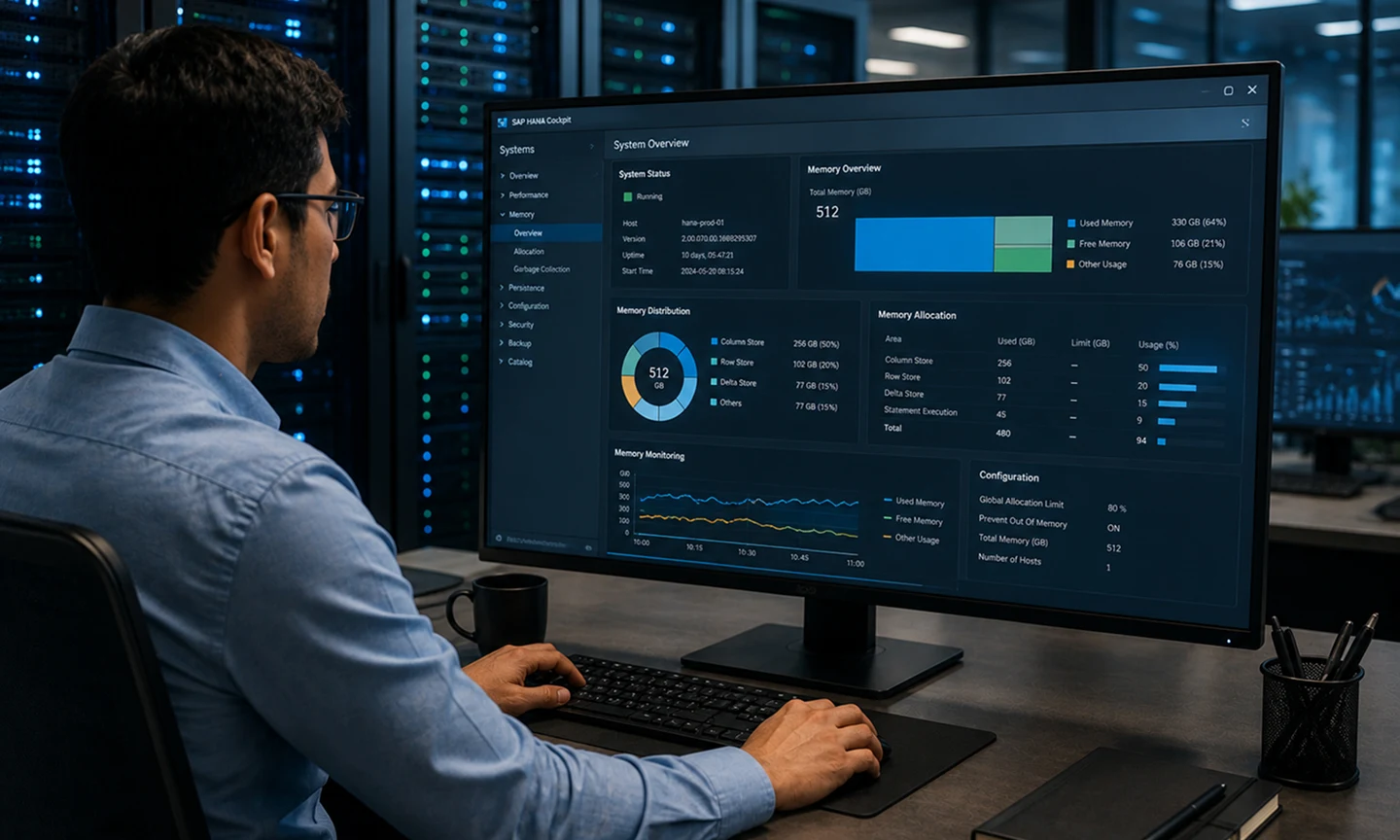
SAP HANA memory management is how the database claims memory from the operating system, shares it across its own components, then gives it back once it’s free. HANA runs in memory, not off disk, so memory is what keeps it quick or brings it down. The number that counts is used memory, the amount HANA genuinely needs at any given moment. Stay on top of that and performance holds. Lose track of it and slowdowns come first, out-of-memory failures soon after.

Most database problems build slowly. You see them coming. HANA memory problems have a habit of arriving overnight, a system that ran clean yesterday paging, stalling, or dropping out-of-memory dumps by morning. Why does it hit that hard? Because the data sits in RAM. The second demand outruns what the host can hand over, there’s no slow disk underneath to limp along on. The thing just stops.

So no, knowing how HANA handles memory isn’t admin trivia you get to skip. It’s the line between spotting a problem on a dashboard and writing the incident report after the fact. The rest of this covers the memory model, the way allocation actually works, what to keep an eye on, and what to do when consumption starts creeping up.

What is Memory Management in SAP HANA?

At its core, memory management in SAP HANA is the database handling its own housekeeping. It pulls memory from the operating system as it needs it, and gives back what it’s finished with. The catch isn’t the idea. It’s the scale and the speed HANA does this at, and the fact that all of it happens in RAM.

And that’s the part that changes how you think about everything else. HANA is an in-memory database. Your tables, indexes, query results, caches, they all live in RAM while the system runs. Disk only comes into it for persistence and recovery, never for everyday reads. In an older database, memory is one knob among a dozen you might tune. In HANA it’s the single constraint sitting over all the rest. It’s also why the platform under AI-powered SAP S/4HANA needs its memory planned with real care to stay steady once the load comes on.

One indicator sits at the center of all of this. Used memory. Get comfortable with that one and most of HANA memory management falls into place.

How SAP HANA Uses Memory

Picture it as layers. At the top is the physical RAM on the host, the hard ceiling. HANA reserves a chunk of that as a pool and works inside it, growing the pool as tables expand or queries need scratch space, and releasing memory lazily when pressure drops.

What it doesn’t do is grab all the RAM and sit on it. HANA allocates on demand and frees in the background, so the amount it has reserved and the amount it’s genuinely using at any second are two different numbers. Confusing those two is where most memory misreads start. For the wider context of how this fits the platform, the SAP S/4HANA architecture breakdown is a good companion read.

So before the troubleshooting makes sense, you need the vocabulary. Here are the memory types.

Key Memory Types in SAP HANA

SAP documents HANA memory as a set of areas, each measured at a different level. Here’s the whole set in one place.

Memory area What it is Why it matters
Physical memory Total RAM on the host The hard ceiling. Nothing exceeds it.
Virtual memory Everything a process has reserved, in RAM plus any paging on disk Includes code, stack, data, and the memory pool. Grows as HANA needs more.
Resident memory The physical RAM processes are actually holding right now What the OS sees HANA occupying.
Allocated memory Total reserved by HANA, capped by the allocation limit Often higher than what’s in use, because HANA frees lazily.
Used memory What HANA actually needs at this moment The most precise indicator. Watch this one.
Shared memory Memory reachable by multiple processes Holds row store components and nameserver topology.
Heap memory Memory private to one process Holds the column store, row store indexes, intermediate results, and the page cache.

Code and stack also exist as areas, but they’re tiny and rarely worth a second look.

SAP HANA Used Memory

Worth its own note, because it’s the number you’ll come back to constantly. SAP HANA used memory is the sum of shared memory and the heap memory currently in use. It tells you what the database genuinely requires right now, stripped of the slack that allocated memory carries. When someone asks “how much memory does HANA actually need,” used memory is the honest answer.

Used Memory vs. Virtual Memory vs. Resident Memory

These three get mixed up constantly, usually because someone reads resident or virtual off an OS tool and panics. The relationships sort it out.

In a healthy HANA host with no paging, where HANA is the only serious memory consumer, the numbers line up like this:

  • Physical memory is greater than virtual memory.
  • Virtual memory equals resident memory, and both are greater than or equal to allocated memory.
  • Allocated memory equals shared memory plus allocated heap memory.
  • Used memory equals shared memory plus the heap memory in use.

Read that and one thing stands out. A query running will move used memory, but it doesn’t necessarily move the process’s virtual or resident size. So if you’re watching the OS instead of HANA’s own indicators, you’ll misread what’s happening.

One more indicator to know. Peak used memory is the highest used memory has reached since the last restart. It’s how you catch a spike that’s already passed, the load test at 2am you’d otherwise never see in a live reading.

Memory Allocation in SAP HANA

The Memory Pool and Lazy Allocation

HANA doesn’t ask the OS for memory transaction by transaction. That would be slow. Instead it reserves a pool up front and serves its own needs from it. When the pool can’t cover a request, the memory manager goes back to the OS for more, up to the limit.

The lazy part matters. HANA holds onto allocated memory rather than returning it the instant a query finishes, on the assumption it’ll need it again shortly. So allocated memory can drift up toward the ceiling while used memory sits well below it. That’s normal. It’s not a leak.

Initial vs Dynamic Allocation

At startup, HANA loads the row store and a baseline set of structures, your initial footprint. From there it’s dynamic. Column tables load as they’re touched, temporary results consume heap during queries, and the pool grows to match. Demand drives the number, not a fixed reservation.

The Global Allocation Limit

This is the cap on how much memory HANA will allocate, and it’s a query worth knowing on its own. By default the global allocation limit is set to 90% of the first 64 GB of physical memory, plus 97% of every GB above that. You can change it through the global_allocation_limit parameter in global.ini, set in MB.

Hit that limit and the memory manager can’t allocate more for anything, internal operations included. Which is the doorway to out-of-memory territory, so it’s worth getting the sizing right early. Memory planning during a move is exactly the kind of thing covered under AI-assisted SAP migration, where readiness assessment flags undersized hosts before go-live rather than after.

Column Store vs. Row Store Memory

The two table stores in HANA use memory differently, and that difference drives a lot of consumption.

Column Store

The column store holds most of your data and is built for reads. It splits into two parts. Main storage is heavily compressed and read-optimized. Delta storage takes the writes with lighter compression, and a delta merge periodically folds those writes back into main.

Two behaviors save memory here. Columns load lazily, on first access, so columns nobody queries never take up space. And under memory pressure, HANA unloads columns it hasn’t touched recently to free room, reloading them when they’re next needed. That unloading is automatic, though you can influence it with unload priorities.

Row Store

The row store is write-optimized and loads fully into memory at startup. It doesn’t unload the way the column store does, and it lives in shared memory. Keep it lean. A bloated row store is memory you pay for at every restart, whether anyone queries it or not.

Monitoring SAP HANA Memory

You can’t manage what you’re not watching, and the old habit of reading memory off the OS will mislead you. Use HANA’s own tools.

SAP HANA Cockpit

Cockpit is the current admin tool for this. It surfaces used memory, peak used memory, the allocation limit, and per-service breakdowns without you writing a line of SQL. If your team is still living in HANA Studio for monitoring, that’s the dated path now. The cockpit is where this lives.

System Views and SQL

When you want detail, the monitoring views give it. A few worth knowing:

  • M_HOST_RESOURCE_UTILIZATION for host-level physical and used memory.
  • M_SERVICE_MEMORY for per-service used, allocated, and peak figures.
  • M_HEAP_MEMORY to see which allocators are eating the heap.
  • M_CS_TABLES for the largest column tables in memory.

SAP also ships a set of memory mini-checks through its SQL statement collection (SAP Note 1969700) that surface the common problems fast.

Tracking Used Memory and Peak Over Time

A single reading tells you almost nothing. Used memory swings with load all day. What you want is the trend, and the peak across a window that includes your heaviest jobs. Continuous tracking is where AI-assisted SAP managed services earns its place, watching memory trends and firing alerts before a slow climb turns into a failed allocation, instead of someone noticing after the fact.

Troubleshooting High Memory Consumption

This is the section you’ll come back to when something’s wrong.

Finding What is Consuming Memory

Start with the heap. M_HEAP_MEMORY shows the top allocators, which usually points straight at the cause, whether that’s a large intermediate result, a runaway statement, or a cache. Then check M_CS_TABLES for oversized column tables. Compare used memory against the allocation limit to see how much headroom is actually left.

Out-of-Memory (OOM) Situations and Dumps

When HANA can’t allocate, either because it hit the allocation limit or the host ran out of physical RAM, it raises a composite out-of-memory error and writes an OOM dump to the trace directory. That dump is not noise. It lists the top memory consumers at the moment of failure, which is often the fastest route to the culprit. SAP Note 1999997 is the standard memory FAQ, and 1900257 covers reading OOM dumps.

Adjusting Memory Parameters

A few levers, used carefully. global_allocation_limit caps total allocation. statement_memory_limit stops a single runaway query from taking the whole system down with it, which is one of the more useful guardrails you can set. Unload priorities tell HANA which column tables to drop first under pressure.

Reducing Memory Consumption

Parameters treat symptoms. To cut the underlying load, the real moves are data aging and archiving to get cold data out of memory, partitioning very large tables, dropping unused indexes and objects, and keeping delta merges healthy so the delta store doesn’t swell. Less data in memory is the only fix that lasts.

Memory Management in Multitenant Database Containers (MDC)

In a multitenant setup, one system database and several tenant databases share the same host RAM. Left uncapped, a single hungry tenant can starve the others. So you set a global_allocation_limit per tenant, in that tenant’s own configuration, to box in how much each one can take. The system database coordinates, but the discipline is the per-tenant cap. On shared infrastructure, getting these limits right is part of a stable AI-enabled SAP Private Cloud foundation, where one tenant’s spike shouldn’t become everyone’s outage.

How Accely Helps You Manage SAP HANA Memory

Most HANA memory trouble isn’t a mystery once you’re in it. The harder part is not being in it. That means sizing the host correctly before migration, setting allocation limits and statement guardrails that fit your actual workload, and watching the trend so a slow climb gets caught while it’s still a chart and not an incident.

That’s the work Accely does with HANA teams. As an SAP Gold Partner with 23 years in SAP delivery, we pair AI-assisted monitoring and proactive alerting with hands-on tuning, from migration sizing through day-two operations. The aim is straightforward. A HANA landscape that stays inside its memory budget, so your team spends its time on the business and not on OOM dumps at midnight.

Conclusion

SAP HANA memory management comes down to one habit. Know what used memory is doing, and keep it comfortably under the allocation limit. Everything else, the memory types, the column and row stores, the monitoring views, the troubleshooting steps, hangs off that.

HANA gives you the indicators and the controls to stay ahead of trouble. The systems that run into memory walls are almost never the ones being watched. They’re the ones where nobody looked until the dump landed.

Sizing a new HANA host, setting allocation limits, or chasing down consumption that keeps climbing? Talk to the SAP expert team and we’ll help you keep the landscape inside its budget.

Frequently asked questions

What is used memory in SAP HANA? +

Used memory is the amount of memory SAP HANA actually requires at a given moment, calculated as shared memory plus the heap memory in use. It’s the most precise indicator of HANA’s real memory footprint, and the main figure to watch, because allocated memory often sits higher due to lazy freeing.

What is the difference between used memory and resident memory? +

Used memory is what HANA genuinely needs right now. Resident memory is the physical RAM the processes are holding, as seen by the operating system. Residents can stay flat while used memory moves with query load, so reading resident off an OS tool can misrepresent what HANA is actually doing.

What is the global allocation limit in SAP HANA? +

It’s the cap on how much memory HANA will allocate. By default it’s 90% of the first 64 GB of physical memory plus 97% of each GB above that. It’s configurable through the global_allocation_limit parameter in global.ini. Reaching it stops further allocation and can trigger out-of-memory errors.

What causes high memory consumption in SAP HANA? +

Usually large column tables held in memory, runaway statements producing big intermediate results, an oversized row store, or a delta store that hasn’t merged. Check M_HEAP_MEMORY for the top allocators and M_CS_TABLES for large tables to find the specific cause before adjusting anything.

How do you check SAP HANA memory usage? +

Use SAP HANA Cockpit for a visual view of used, peak, and allocated memory, or query the system views directly. M_HOST_RESOURCE_UTILIZATION gives host-level figures, M_SERVICE_MEMORY gives per-service detail, and M_HEAP_MEMORY shows the largest allocators. SAP’s memory mini-checks (Note 1969700) surface common issues quickly.

What causes an out-of-memory (OOM) dump in SAP HANA? +

An OOM happens when HANA can’t allocate memory, either because it reached the global allocation limit or the host ran out of physical RAM. HANA writes a dump to the trace directory listing the top consumers at the moment of failure, which is the fastest starting point for diagnosis.

Profile

Vikas Chopra

Practice Head SAP S/4HANA

Copy link

SAP Solution Architect with 23+ years in logistics and SCM. Expert in SAP S/4HANA with hands-on experience in global rollouts, upgrades, and enterprise solution delivery.

SAP BDC Integration: Datasphere, Analytics Cloud, & Others

SAP BDC Integration: Datasphere, Analytics Cloud, & Others

SAP Analytics Cloud

Published: April 15, 2026

Banner

SAP BDC integration works through data products, not point-to-point connectors. SAP applications publish governed data products into Business Data Cloud, Datasphere harmonizes and models them, and Analytics Cloud consumes them. Systems and components are grouped into formations.

Third-party tools like Databricks, Snowflake, and Microsoft Fabric connect through BDC Connect using zero-copy Delta Sharing, so data stays put instead of being copied around. That’s the shape of it.

Most people searching “SAP BDC integration” already know what Business Data Cloud is. What they actually want is the wiring diagram. How does data get in? How do Datasphere and Analytics Cloud fit together? And what happens when half your stack lives outside SAP, in Databricks or Salesforce or a warehouse nobody wants to rip out?

Here’s the part that trips people up. Integration in BDC doesn’t look like the connector spaghetti you might picture. It runs on a small set of concepts: data products, formations, and BDC Connect. Get those three, and the rest of this falls into place fast.

What Does SAP BDC Integration Actually Mean?

In older SAP landscapes, integration meant building pipes. Extract from one system, transform it somewhere, load it into another, then maintain that chain forever.

BDC flips the model. SAP applications publish their business data as curated, SAP-managed data products into Business Data Cloud. A data product is a ready-to-use, governed dataset built on SAP’s own business process definitions, so you’re not reverse-engineering table structures to figure out what a field means. Datasphere sits in the middle, between those data products and whatever consumes them, adding the business semantics that make the data usable.

So integration here is less about moving data and more about publishing, harmonizing, and sharing it. Less plumbing. More assembling.

The Building Blocks of BDC Integration

Three concepts carry the whole SAP BDC architecture. Worth pinning each one down before going further.

Data Products

The unit of integration. Instead of raw tables, SAP packages business data into governed products, finance, HR, supply chain, and so on. Because SAP manages them, you can’t rewrite their structure, but you can extend and enrich them, combine them with your own data, or push them out to a tool like Databricks. To use one, you find it in the catalog inside your Datasphere tenant and install it into a space. That’s genuinely most of the work.

Formations

A formation is how you group things. It bundles the source systems plus the core components, Datasphere, Databricks, and Analytics Cloud, that consume, enrich, and visualize the data. And you’re not stuck with one. You can run separate Dev, Test, and Production formations to mirror a normal three-system landscape, which matters the moment you take BDC integration past a proof of concept.

Intelligent Applications

The fastest route in. Intelligent Applications are SAP-delivered packages with the data models already built in Datasphere, the data products already wired, and the Analytics Cloud stories ready to go. Install one and you’ve got working reporting with very little assembly. One catch worth knowing: because their models live in Datasphere, any formation running an Intelligent Application has to include Datasphere. In practice, that’s every formation.

How SAP Datasphere Integrates Data in BDC

Datasphere is the center of gravity. Data products on their own are rarely enough to hand straight to a dashboard. They’re missing the business context, the relationships, the meaning. Datasphere is where that gets added.

Harmonizing and Modeling Data Products

You install data products into a Datasphere space, then build models on top. You can layer on calculations, apply filters for business context, or combine an SAP data product with a customer or partner dataset to make something none of the sources gave you alone. The models you build become the foundation everything downstream reads from.

The Semantic Layer

This is the quiet value. Datasphere lets you define what a field actually means, currency, unit of measure, hierarchy, the aggregation behavior of a measure, once, centrally. Then every consumer reads it the same way. No two teams arguing over which revenue number is the real one. Governance is part of this too: you set data access controls that decide who sees what, and because that lives in the model, it travels with the data. This is also where lineage and compliance get real, which is why SAP cloud data security is worth reading next to this.

Replication Flows vs Zero-Copy

Two ways data lands in a Datasphere space. Replication flows physically load it from the Foundation Services into local tables. Or zero-copy through Delta Sharing, where the data stays at the source and you query it in place. SAP has been moving toward the delta share protocol in Datasphere specifically to avoid replicating into local tables. The direction of travel is clear: less copying, more sharing.

Integration is where BDC projects live or die.

We’ll connect your SAP and non-SAP sources into one governed layer, cleanly.

How SAP Analytics Cloud Consumes BDC Data

If Datasphere is the kitchen, Analytics Cloud is where the food gets served. It’s the consumption front end, not a separate system you bolt onto BDC.

Stories and Dashboards

Analytics Cloud reads the models Datasphere exposes. Build a story or dashboard directly on a governed BDC model and the numbers are trustworthy by default, because the semantics and access rules came along for the ride. The same tooling behind SAP Analytics Cloud platform is what teams use for this.

Planning on the BDC Foundation

Planning runs on the same foundation as reporting, so your forecasts sit on the same governed data as your actuals. No reconciling two versions of the truth before a planning cycle even starts.

Joule and Natural-Language Analytics

The newer layer, and a fast-moving one. Joule Agents now let users discover and create data products through natural language, performing joins and transformations automatically and applying governance policies, while business users ask analytical questions in plain language and get context-aware answers across lines of business. The knowledge graph is what makes that work, since it understands the relationships between your data, not just the values.

Integrating SAP S/4HANA, BW, and SuccessFactors

Most BDC integration starts with SAP sources. Each has its own path.

S/4HANA as a Data Product Source

S/4HANA is usually the anchor. It publishes business-ready data products straight into BDC, finance from the Universal Journal, procurement, sales, and the rest, so the system of record becomes a governed source without a custom extraction project. Mapping those sources before you start is where the SAP migration system earns its place, especially if your landscape is mid-transition. The S/4HANA deployment options also shape how this connects.

BW and BW/4HANA Modernization

Decades of BW modeling don’t have to be thrown out. The BW Data Product Generator turns existing warehouse content into managed data products, and BW Bridge gives you a cloud path that lets you decommission the old warehouse gradually rather than in one nervous weekend.

SuccessFactors and Line-of-Business Sources

HR data through SuccessFactors, plus other line-of-business systems, publish as data products the same way. The pattern holds no matter the source: publish, harmonize in Datasphere, consume in Analytics Cloud.

Third-Party Integration With BDC Connect

This is where BDC integration gets genuinely interesting, and where the old “build an ETL pipe” instinct dies.

Databricks

The headline integration. BDC Connect for Databricks gives secure, zero-copy access to SAP data products through Delta Sharing, with everything governed in Unity Catalog and no replication or external ETL. Datasphere handles governed modeling and business semantics. Databricks handles large-scale processing, external data, and model training. You model in one and use it in the other without copying anything between them.

Snowflake, Google BigQuery, and Microsoft Fabric

The ecosystem is widening. Snowflake, Google BigQuery, and Microsoft Fabric all join the zero-copy sharing ecosystem, with general availability planned for H2 2026. Same principle every time. Business context is managed once, centrally, in BDC, and the data stays where it lives.

Salesforce and Operational Systems

Non-SAP operational data fits the picture too. A typical pattern: S/4HANA publishes data products into BDC, Salesforce data is ingested separately, both get governed together, then joined and served for analytics, all without duplicating data or running external ETL. CRM and ERP, finally reading from one trusted view.

Master Data With Reltio

Newer still. SAP’s Reltio acquisition brings multi-domain master data management directly into BDC, to unify, cleanse, and harmonize data across SAP and third-party sources. Clean master data is the thing most integration projects underestimate, so this one matters more than it looks.

Governance and Security Across Integrations

Worth its own section, because integration without governance is just a faster way to make a mess.

Governance in BDC isn’t bolted on after the fact. Data products are governed at the source. Access controls live in the Datasphere models, so they apply wherever the data is consumed. When data moves to Databricks, Unity Catalog carries the lineage and permissions. The point is that one set of rules follows the data across every hop, instead of each tool inventing its own. For regulated industries, that single thread of governance is often the reason BDC wins the architecture conversation at all.

Industry Use Cases

Manufacturing

A manufacturer publishes S/4HANA production data as data products, enriches it in Datasphere, then runs the combined picture through Databricks for predictive maintenance and yield models. Sensor data from outside SAP joins through BDC Connect. One loop, not three disconnected systems.

Retail

Retail runs on data that rarely lines up: POS, inventory, loyalty, plus whatever marketing platform is in play. Data products harmonize the SAP side, BDC Connect brings in the non-SAP tools, and merchandising teams get governed demand and replenishment views without a custom build for every report.

Banking and Financial Services

Banks need governed, auditable data for risk and regulatory work, and serious compute for fraud and credit models. The split fits cleanly. Datasphere supplies the governed layer, Databricks runs the models, and governed lineage holds the whole thing together for the auditors who will absolutely ask.

Implementation Considerations and Best Practices

Planning Your Formations

Decide your formation structure before you build. Map which source systems feed which components, and set up separate Dev, Test, and Production formations from the start. Retrofitting that later is painful.

Data Product and Governance Strategy

Before turning on Joule or wiring up third-party connectors, settle which datasets are authoritative, how they’re governed, and who can use them. That catalog is what makes everything downstream, especially the AI, trustworthy. Skip it and you’re building on sand.

Phased Rollout vs Big-Bang

Phased almost always wins. Start with one source and one Intelligent Application, prove the loop end to end, then widen. Big-bang integrations look efficient on a slide and rarely survive contact with real data.

Monitoring and Optimization

Integration isn’t done at go-live. Watch replication health, query performance, and consumption patterns, and tune as usage grows. This is the kind of ongoing work AI-assisted SAP managed services is built to carry, so it doesn’t fall on a team already stretched.

Zero-copy sounds simple. The setup rarely is.

We’ll scope your Databricks, hyperscaler, and BW connections before you commit.

How Accely Helps With SAP BDC Integration

The hard part of BDC integration isn’t clicking install on a data product. It’s the design decisions around it. Which formations, which sources first, how the governance model should work, and where the line sits between Datasphere modeling and Databricks engineering.

That’s our lane. As an SAP Gold Partner with 25+ years in SAP delivery, we run AI-assisted assessments of your current landscape, then design the AI-enabled SAP Business Data Cloud integration around how you actually operate, formations, data products, third-party connectivity, the lot. The aim is an integration that holds up as you scale it, not a proof of concept that quietly breaks the first time real volume hits it.

Conclusion

SAP BDC integration is simpler to reason about once you drop the old pipe-building mental model. Data products are how data gets published. Formations are how systems and components are grouped. Datasphere harmonizes and adds meaning. Analytics Cloud consumes it. And BDC Connect extends the whole thing to Databricks, Snowflake, Fabric, and beyond with zero-copy sharing.

The shift is from moving data to publishing and sharing it, with governance running through every step instead of being patched in at the end. That’s what makes BDC integration scale where older approaches stalled.

Planning a BDC integration, or trying to work out which sources and formations to start with? Talk to Accely’s SAP consultation team and we’ll map it to the landscape you actually have.

Frequently asked questions

What is a data product in SAP BDC? +

A data product is a curated, SAP-managed dataset built on SAP’s business process definitions, published from applications like S/4HANA into Business Data Cloud. It’s the unit of integration in BDC. You install data products into Datasphere spaces and build models on them, rather than extracting raw tables and rebuilding the business meaning yourself.

What is a formation in SAP BDC architecture? +

A formation groups the source systems and core components, Datasphere, Databricks, and Analytics Cloud, that ingest, enrich, and consume data together. You can create separate Dev, Test, and Production formations to mirror a standard three-system landscape, which keeps non-production work isolated from live data.

How does SAP BDC Connect work? +

BDC Connect shares data between Business Data Cloud and third-party platforms using zero-copy Delta Sharing. Data stays at the source instead of being replicated, and governance and lineage carry across. It currently supports Databricks, with Snowflake, Google BigQuery, and Microsoft Fabric joining the ecosystem through 2026.

Can you integrate non-SAP data with SAP BDC? +

Yes. Non-SAP data integrates through BDC Connect and Datasphere. Tools like Databricks and Salesforce connect via Delta Sharing or ingestion pipelines, and the data is governed alongside SAP data products. You can combine SAP and non-SAP sources in a Datasphere model without duplicating data across systems.

Does SAP BDC integration require Databricks? +

No. SAP Databricks is a core component for data engineering and AI workloads, but BDC integration through data products, formations, Datasphere, and Analytics Cloud works without leaning on it. How much you use Databricks depends on your machine learning and external-data needs.

How does SAP BDC integrate with SAP S/4HANA? +

S/4HANA publishes business-ready data products directly into BDC, including finance data from the Universal Journal, procurement, and sales. Those products are harmonized in Datasphere and consumed in Analytics Cloud, so S/4HANA becomes a governed source without a custom extraction project.

Profile

Muralidharan Venkataraman

Global Head Delivery & Presales

Copy link

30+ years of experience managing large, complex SAP programs across industries, geographies, and functions. Expert in enterprise-scale transformation and program governance.

Extension Ledger in SAP S/4HANA: Features, Setup, and Benefits Explained

Extension Ledger in SAP S/4HANA: Features, Setup, and Benefits Explained

SAP ERP

Published: March 25, 2026

Banner

An extension ledger in SAP S/4HANA sits on top of a standard ledger and records only delta postings, meaning the specific adjustments you need for one reporting view. It doesn’t copy the base ledger’s data. When you run a report, SAP reads both ledgers together. So you get a way to handle tax adjustments, management entries, and predictive accounting without building a second full ledger to do it.

Ask a finance team how many versions of their numbers they keep, and the honest answer is always more than one. There’s the statutory view. The group view. A tax view. Then whatever shape management wants this quarter. Same underlying figures, reshaped four different ways.

Standing up a full ledger for each of those is slow, and it bloats your data. The extension ledger is SAP’s answer to that problem. It lets you record adjustments on top of a ledger you already have, without copying anything or going near your core books.

Below: what it is, how it differs from a non-leading ledger, how it actually works, where predictive accounting comes in, what it can’t do, and how to configure one.

What is an Extension Ledger in SAP S/4HANA?

An extension ledger pulls its data from an underlying standard ledger and stores only the extra postings you make against it. Those extras have a name in SAP. Delta postings.

The base figures are inherited, not copied. So the extension ledger only ever holds the difference, nothing else.

All of it lives inside the Universal Journal, the single ACDOCA table that carries finance line items in AI-enabled SAP S/4HANA. One table for every posting. That’s the thing that lets you report on the standard ledger by itself, the extension ledger by itself, or the two read together, without stitching data from different places. For the wider map of where finance sits in the suite, the overview to SAP S/4HANA modules is a decent starting point.

A standard ledger is your book of record. An extension ledger is a see-through layer on top of it, holding entries you want in a specific report but nowhere near your core books.

SAP S/4HANA Finance and the General Ledger

In SAP, the general ledger is where financial accounting lives. Every business transaction lands on a G/L account, and from there the ledger gives you the full financial position, broken out by company code, segment, profit center, whatever dimension you report on.

S/4HANA changed how this works under the hood. The old setup kept separate tables for the G/L, controlling, asset accounting, the material ledger. S/4HANA folded all of that into one line-item table, ACDOCA, shared across every module. And that shared table is the whole reason extension ledgers can exist. The data already sits in one place, so SAP can layer a ledger over it and read both at runtime.

If you want a closer look at the finance side, the S/4HANA finance module breakdown goes deeper. From here on, we stay on the extension ledger.

Types of Ledgers in SAP S/4HANA

Two ledger families matter before the extension ledger makes sense. Standard ledgers, and the extension ledger itself.

Standard Ledger

A standard ledger carries the full record of your financial transactions. S/4HANA gives you two kinds of it.

The leading ledger (0L) is the primary one. It usually runs your group accounting principle, often IFRS. Every company code reports to it, and postings cascade down from there.

A non-leading ledger runs in parallel for a different principle, normally local GAAP or tax. The key point: it stores a complete set of values on its own. That’s what makes it fit for statutory reporting in a given country.

Extension Ledger

The extension ledger isn’t a standalone book. It points at a base ledger and records only delta entries against it. If the base ledger already shows a number, the extension ledger inherits it and posts your adjustment on top. Which is exactly why it carries a sliver of the data a full ledger does.

Most teams use it as a tax or management overlay. Legal numbers stay in the base ledger. The adjustments only one audience cares about go in the extension ledger.

Extension Ledger vs Non-Leading Ledger

This is the comparison people get stuck on, because both touch parallel reporting. What separates them is what they store, and what you’d reach for them to do.

  Non-Leading Ledger Extension Ledger
Data stored Full set of values Delta postings only
Depends on a base ledger No, self-contained Yes, reads from a base ledger
Storage footprint Higher Low
Typical use Statutory and legal reporting under a local GAAP Adjustments, management reporting, predictive accounting
Replaces core books Can act as a parallel book of record No, it’s an overlay

A quick way to decide. Does the view need to stand on its own as a legal book? Non-leading ledger. Is it just an adjustment layer on figures that already exist? Extension ledger.

Key Features of the Extension Ledger in SAP S/4HANA

Worth being precise here, because people blur the two constantly. These are extension ledger features, not general ledger features.

Derivation from the Standard Ledger

Every extension ledger ties to an underlying ledger, usually 0L, and reads its data automatically. You never key the base figures again.

Delta Posting

You post the difference, and only the difference. A tax adjustment, a management accrual, a reclassification, all of it goes into the extension ledger and stops there. The base ledger doesn’t move.

Storage Efficiency

Nothing gets duplicated, so the data footprint stays small. SAP merges the base values with the delta entries on the fly when you run a report. On a system pushing serious transaction volume, that saved space adds up fast.

Parallel and Scenario Reporting

You can run parallel accounting and what-if scenarios without standing up a stack of full ledgers. Each extension ledger is its own view, layered on the same actuals. Handy when consolidation and adjustment cycles start piling on top of each other, and it works well alongside AI-powered SAP Group Reporting for catching anomalies during consolidation.

Integration with the Universal Journal

Base postings and delta postings all sit in ACDOCA. Same table, same reporting tools, and the numbers reconcile whether you’re looking at the standard ledger, the extension ledger, or both at once.

How Does the Extension Ledger in SAP S/4HANA Work?

Three moving parts, really. How the data flows, how postings get tagged, and how a report stitches it all back together.

Data Flow

Run a report and SAP grabs the base figures from the standard ledger, then drops the extension ledger’s delta entries on top. Nothing’s calculated ahead of time or held in two places. The merge happens live, at the moment you run it.

Posting Mechanism

Anything posted to an extension ledger gets tagged to its ledger group, so it only ever touches that ledger. The base ledger never sees it. That isolation is the entire point. You record an adjustment, it shows up in one report, and your legal books don’t budge.

Reporting

You pick the lens. Standard ledger for the legal numbers. Extension ledger to see the adjustments on their own. Both, for the adjusted picture. One data source, three ways to read it.

Extension Ledger and Predictive Accounting in SAP S/4HANA

Here’s where the extension ledger earns its keep, and it’s the part most overviews skip past.

How Predictive Accounting Uses the Extension Ledger

Predictive accounting shows you the financial impact of something that hasn’t been posted yet. Create a sales order and there’s no actual revenue, so the standard ledger records nothing. Predictive accounting instead writes a statistical entry into an extension ledger. Your actuals stay clean. The forecast sits right next to them, separate.

Worked Example: Forecasting from a Sales Order

Say a manufacturer takes a sales order worth 50,000 USD. Nothing’s shipped, so the leading ledger 0L stays empty on this one for now.

Predictive accounting posts to the extension ledger, call it N1:

  • Predicted accounts receivable: 50,000 USD
  • Predicted revenue: 50,000 USD

Then the goods go out, the invoice posts, real revenue hits 0L, and that predictive entry in N1 drops away. A report reading 0L plus N1 shows you booked revenue and the pipeline you expect to land, in one view. Committed and expected, side by side, neither one polluting the other.

Real-Time Forecasting and AI-Enabled Planning

Once those predictive entries are flowing, they turn into a feed for forward-looking analysis. That data carries cleanly into AI-enabled predictive forecasting, where models read committed actuals and predicted pipeline together and flag variances earlier than any manual review would. The extension ledger keeps prediction and actual apart at the source. That separation is what makes the downstream analysis worth trusting.

Benefits of the Extension Ledger in SAP S/4HANA

Faster Setup With No Data Migration

Configuration, not a data project. There’s no migration to run. Configure it, and it reads existing data straight away, with historical figures coming through the base ledger.

Lower Data Footprint

Delta-only storage means you add a reporting layer without paying the storage cost of a full parallel ledger. On high-volume systems, that gap is real money.

Reuse of Existing Reports

Standard ledger reports just work with extension ledgers. Analytical apps and old-school SAP GUI reports both read the combined view, so you’re not rebuilding a reporting stack from scratch.

Flexible Parallel and Management Reporting

Carve out a separate view for management, tax, or a what-if scenario, and the legal books stay untouched. Every view is its own overlay.

Reduced Risk to Core Ledgers

Adjustments are boxed into the extension ledger, so the odds of a management or tax entry quietly distorting your statutory numbers drop to roughly nil. Your book of record stays exactly that.

Limitations: What the Extension Ledger Cannot Do

It’s an overlay, not a stand-in for a standard ledger. Knowing the edges keeps you from designing yourself into a corner you can’t post your way out of.

  • No postings to customer or vendor reconciliation accounts.
  • No postings to G/L accounts under open item management.
  • No integration with Asset Accounting.
  • Limited support for automatic processes like G/L allocations.
  • It leans on its base ledger, so it can’t run independent business processes alone.
  • It’s built for adjustments, reporting, and predictive entries, not core legal ledger accounting.

If a requirement trips any of those, the answer is a non-leading ledger or a different design, not an extension ledger forced into a job it wasn’t built for.

Use Cases and Scenarios for Extension Ledgers

Local Tax vs IFRS Adjustments

A company reports group results under IFRS in the leading ledger, then needs local tax adjustments, accelerated depreciation, tax-deductible provisions, that sort of thing. Those go into the extension ledger. Both views stay compliant, and nothing’s duplicated to get there.

Management and Topside Adjustments

Management reporting wants regroupings and reclassifications that have no business sitting in the legal books. The extension ledger holds those topside adjustments cleanly, so the management view and the statutory view trace back to the same actuals.

Post-Closing and Period-End Entries

Entries booked after a period closes, or corrections you only want visible in one report, fit the model neatly. The closed standard ledger never gets touched.

Forecasting and Predictive Scenarios

Covered this above, so just to place it: predictive accounting and what-if runs both lean on the extension ledger to keep forward-looking entries away from your actuals.

How to Set Up an Extension Ledger in SAP S/4HANA

Setup happens in configuration (SPRO). Menu wording shifts a little between releases, so check it against your own system. The flow itself holds steady.

Creation Procedure

Head to Financial Accounting, then Financial Accounting Global Settings, then Ledgers, then Ledger, then Define Settings for Ledgers and Currency Types. Create the new ledger, set its type to extension ledger, and point it at the base ledger it should read from, usually 0L.

Company Code Settings

Open company code settings for the new ledger. It inherits the company code assignments from its base ledger, so before you post anything, double-check the company codes you expect are actually there.

Assigning Accounting Principles

Assign an accounting principle. Nine times out of ten it mirrors the reference ledger’s principle, so the overlay reports on the same basis as the book underneath it. Principle assigned, and the ledger’s ready for delta postings.

Implementing Extension Ledgers With Accely

Most extension ledger projects don’t come apart at configuration. They come apart at design. The technical build is a day’s work. Deciding which views belong in an extension ledger, which need a full non-leading ledger, and how predictive accounting should feed your planning, that’s where the real time goes, and where the expensive mistakes hide.

That’s the part Accely works on with finance teams. As an SAP Gold Partner with 26+ years in SAP delivery, our consultants run AI-assisted analysis across your current ledger setup and data quality, then map each reporting requirement to the right ledger design before anyone opens SPRO. Parallel reporting structures, predictive accounting, the move onto SAP financial management for teams modernizing the close. The point is a ledger architecture that reports right the first time, instead of one you spend a quarter unpicking.

Conclusion

The extension ledger does one job, and does it well. It gives you an adjusted or forward-looking view of your finances without a second full ledger and without putting your legal books at risk. Delta postings, a light data footprint, and a hard line between actuals and everything layered above them.

It won’t fix every reporting need. It can’t replace a standard ledger, and it runs into real walls around reconciliation accounts and asset accounting. Used for what it’s built for, though, adjustments, management reporting, predictive accounting, it’s one of the more genuinely useful tools in S/4HANA Finance.

Weighing an extension ledger against a non-leading ledger, or planning predictive accounting on your current setup? Get that design call right before you configure a thing. Talk to Accely’s SAP expert team and we’ll map it to how you actually report.

Frequently asked questions

What is an extension ledger in SAP S/4HANA? +

It’s a ledger that derives its data from a standard ledger and records only delta postings against it, without duplicating the base ledger’s data. SAP reads the standard and extension ledgers together at report time, which makes it an efficient way to handle adjustments and parallel reporting.

What is the difference between an extension ledger and a non-leading ledger? +

A non-leading ledger stores a full, self-contained set of values and can serve as a statutory book of record. An extension ledger stores only delta entries on top of a base ledger and depends on it. Use a non-leading ledger for legal reporting, an extension ledger for adjustments and management views.

Can an extension ledger replace a standard ledger? +

No. It’s an overlay, not a replacement. It can’t post to reconciliation accounts or open-item-managed accounts, has no Asset Accounting integration, and relies on its base ledger. It’s meant for adjustments, reporting, and predictive entries, not core legal accounting.

What is a delta posting in an extension ledger? +

A delta posting is the adjustment you record only in the extension ledger. The base ledger’s values are inherited automatically, so you post just the difference. These entries are tagged to the extension ledger’s ledger group and never affect the underlying standard ledger.

How does predictive accounting use the extension ledger? +

Predictive accounting writes statistical entries from operational documents, like sales orders, into an extension ledger before any actual posts. Actuals stay in the standard ledger. Reports reading both together show booked and expected figures side by side, with the forecast never touching your real financial records.

How do you configure an extension ledger in SAP S/4HANA? +

In configuration, create a new ledger, set its type to extension ledger, and assign its base ledger, usually 0L. Confirm the company code assignments, then assign an accounting principle, normally the same one as the reference ledger. No data migration needed.

Profile

Vikas Chopra

Practice Head SAP S/4HANA

Copy link

SAP Solution Architect with 23+ years in logistics and SCM. Expert in SAP S/4HANA with hands-on experience in global rollouts, upgrades, and enterprise solution delivery.

Unifying Analytics with SAP BDC: How Datasphere and SAP Analytics Cloud Work Together

Unifying Analytics with SAP BDC: How Datasphere and SAP Analytics Cloud Work Together

SAP Analytics Cloud

Published: March 11, 2026

Banner

Analytics with SAP BDC means your reporting, planning, and AI all run off one governed data layer, not three tools that don’t talk. SAP Business Data Cloud is the managed platform that makes that happen. Datasphere does the data work underneath. SAP Analytics Cloud is what people use up top for reports and planning. Databricks handles machine learning. Because they pull from the same model, a number on a dashboard matches the number a forecast uses, and the one an AI agent quotes back to you.

Ask three teams for last quarter’s revenue and you’ll often get three numbers back. Nobody’s lying. The data just lived in different systems, got pulled at different moments, and had quietly drifted in meaning by the time it hit a slide. Closing that gap is the entire job of unified analytics.

SAP Business Data Cloud is SAP’s go at fixing it properly. Here’s the bit most write-ups bury, though: BDC isn’t a shiny new tool. It’s three you probably already know, Datasphere, SAP Analytics Cloud, and a Databricks engine, finally running off one shared, governed set of data. Below, how that happens, what each piece does, and what it takes to get there.

What Unified Analytics in SAP BDC Actually Means

Most analytics problems aren’t really analytics problems. They’re data problems in an analytics costume. Reporting crawls because someone had to pull extracts and stitch them together first. Planning leans on a reconciliation nobody quite trusts. Sales and finance can’t even agree on what counts as a customer.

Unified analytics turns that around. You settle the definitions once, in one governed semantic layer, and everything built on top reuses them. In SAP Business Data Cloud, every tool shares that layer. So a dashboard, a forecast, and a Joule answer all trace back to the same governed model, and they stop contradicting each other. The win isn’t better-looking charts. It’s meetings where people argue about the decision instead of whose number is right.

The Three Components of Analytics in SAP BDC

The SAP Business Data Cloud architecture clicks faster once you stop picturing a product and start picturing three roles, plus the wiring that connects them. Accely’s work on AI-enabled SAP Business Data Cloud runs across all of it.

SAP Datasphere, the Data and Semantic Foundation

Datasphere sits underneath the lot. It connects your SAP and non-SAP sources, models them, and stamps business meaning onto them, so what comes out the other side is a governed product, not a raw table. It runs on SAP BTP; this guide to SAP BTP covers that foundation if you want it. The simplest way to hold it: Datasphere is the part that decides what the data means before anyone reports a thing.

SAP Analytics Cloud, the Analytics and Planning Layer

SAP Analytics Cloud is where the actual work gets done. Dashboards, reports, planning models, predictive bits, one front end for all of it. It links live to Datasphere, so nothing gets copied and no rogue second version of the truth appears. It’s the same tooling behind the AI-enabled SAP Analytics Cloud platform. What makes SAC count inside BDC is that live link: a CFO pulls up revenue and the figure comes straight from the governed model, not some local extract from last Tuesday.

SAP Databricks, the Data Science and ML Engine

Databricks takes on the heavy work Datasphere and SAC weren’t built for. Machine learning. Large-scale processing. Training models on outside data. It shares data with BDC through a zero-copy setup, so models run without hauling data out and back in again. Datasphere hands the models their business context; Databricks brings the raw horsepower.

Tying it all together: the Foundation Services and the Data Product Studio, where governed data products get defined and published. Plus a way off legacy, since BW and BW/4HANA modernize into BDC instead of getting scrapped. And for anyone leaning into Joule and agentic analytics, that same governed layer is what makes SAP Business AI solutions trustworthy rather than a guessing game.

How SAP BDC Unifies Analytics: The Data Journey

Now the part most explainers skip. They name the components and leave you to imagine the wiring. So let’s actually follow one question all the way through.

Say finance wants to know which customers are about to pay late.

  1. Receivables sit in S/4HANA. Customer and contract data is scattered across CX and a few other systems. Individually, none of it answers anything.
  2. Datasphere pulls those sources in, models them, and resolves them into one governed view where “customer” means the same thing in every corner. What you get out is a data product, not a tangle of joins.
  3. SAC connects live to that product and puts rising DSO and overdue accounts on a dashboard. Nothing replicated, and the security and access rules ride straight through from Datasphere.
  4. Databricks trains a model on that same governed data to flag which accounts are likely to slip, then writes the scores back for BDC to use.
  5. Plan and act. Finance reworks the cash-flow forecast in SAC, on the exact model they were just staring at, and Joule fields the follow-up questions off the same layer.

One question. Four tools. Not a single handoff where the meaning of the data shifted. That’s the gap between technically consolidated and actually unified.

SAP Datasphere vs SAP Analytics Cloud: Roles Within BDC

People muddle these two all the time, mostly because both have “analytics” energy. Inside BDC they do genuinely different jobs, and once it’s laid out the split is obvious.

SAP Datasphere SAP Analytics Cloud SAP Databricks
Primary role Data and semantic foundation Analytics and planning front end Data science and ML engine
What it does Connects, models, and governs data into products Dashboards, reports, planning, predictive ML models, heavy processing, external data
Where it sits The layer under everything The layer users interact with Alongside, via zero-copy sharing
Best for Getting data governed and ready Turning data into decisions Heavy AI and ML workloads


So, Datasphere versus SAP Analytics Cloud in a sentence: one gets the data ready and governs it, the other turns it into decisions. Databricks does the AI-grade math off to the side. None of them are fighting for the same job. It’s a relay, each one handing off to the next.

Three tools, one governed layer. Getting the model right is the hard part.

We’ll design the semantic layer so your reports, plans, and AI finally agree.

Data Products and Insight Apps

One real edge BDC has over wiring these tools together yourself is the content that ships with it. Data products are governed, ready-to-use datasets packaged out of SAP systems, so you’re not modeling everything from a blank page. Insight Apps (sometimes called Intelligent Applications) go further still: complete analytical apps that SAP builds and runs, bundling the data models, the processes, and the dashboards into one thing you install.

BW customers get the BW Data Product Generator, which turns existing warehouse content into these products. Years of modeling come along for the ride instead of getting binned. Net result? Less plumbing, and a far shorter trip from raw data to a report someone can actually use.

A Unified Analytics Use Case

Take that days-sales-outstanding problem from earlier and run it all the way out. A finance team watches DSO creep upward, overdue receivables stacking up. That’s a real liquidity risk, not a reporting nicety.

Datasphere governs the receivables and customer data into a single model. SAC surfaces the high-risk accounts and the trend on a dashboard. Databricks trains a payment-delay model on that same governed data and scores every account, and those scores flow back into SAC, where finance reworks the cash-flow forecast on the very model it just analyzed. One governed dataset, carried from raw transaction through prediction to plan, and nowhere along the way did someone re-export the numbers and snap the chain. That unbroken thread is the whole point, and it’s genuinely hard to fake when your tools are disconnected.

What Unified Analytics in BDC Is Not

Worth drawing a few hard lines here, because the marketing around BDC tends to smudge them.

  • It doesn’t run your business processes. BDC is the data and analytics layer. The actual transactions still fire in S/4HANA and the rest of the Business Suite.
  • It isn’t a rip-and-replace of Datasphere or SAC. It’s built on top of them. Already running those? You’re most of the way there already.
  • It’s not just a rebrand. The Databricks engine, the managed data products, the knowledge layer, those are genuinely new bolted onto the older parts.
  • It isn’t mandatory overnight. Your existing Datasphere and SAC tenants keep humming along. You make the move when the value earns it, not because some slide said to.

Migrating to Unified Analytics in 2026

If You Already Run Datasphere and SAC

You’re in the best position. The move is rewiring your current tenants into the BDC framework, not rebuilding from nothing, and SAP is rolling out services to keep that conversion clean, down to converting your Datasphere compute units for use in BDC. Treat it as an upgrade. SAP migration process handles the assessment side, mapping what you’ve got before anything moves.

If You’re on BW or BW/4HANA

BDC was built with your route in mind. BW and BW/4HANA can run as Private Cloud Edition inside BDC, supported through 2030, so you modernize on your own clock instead of a big-bang cutover. And the BW Data Product Generator turns existing models into data products you can use in SAC straight away.

The SAC Dual-Storage Transition

One thing not to sleep on. Analysts have flagged that SAC’s underlying dual-storage model is mid-transition as SAP reworks the architecture beneath it. Teams that drag their feet on BDC readiness risk friction in their analytics pipelines down the line. Smart move is to take stock of your current SAC and Datasphere setup now, and map what a transition would actually involve, long before it turns urgent.

The SAC dual-storage shift is coming. Better to plan it now.

We’ll assess your current Datasphere and SAC setup and map the move to BDC.

Your Unified Analytics Roadmap

You don’t unify analytics in a single project. You build toward it. A workable sequence:

Assess. Inventory what you’ve got across Datasphere, SAC, and BW, and pin down the high-value analytics or AI use cases worth tackling first.

Foundation. Stand up BDC Foundation Services and wire your priority sources, S/4HANA and friends, into a governed layer.

Quick win. Ship an Insight App or one governed use case that proves real value in weeks, not quarters.

Expand. Pull in Databricks for ML, add data products across more domains, and widen the unified layer out from there.

How Accely Helps You Unify Analytics on SAP BDC

The hard part of unifying analytics isn’t standing up the tools. It’s the sequence: which moves first, which use case proves value fastest, and getting the semantic model right so everything stacked on top of it actually holds.

That’s our lane. As an SAP Gold Partner with 25+ years in SAP delivery, we run AI-assisted assessments of where your data and analytics stand today, then chart the path: tenant rewiring if you’re already on Datasphere and SAC, BW modernization if you’re not, and the governed data products that make the whole thing actually work. The goal is analytics that agree with each other, built on SAP Business Technology Platform and the wider Business Data Cloud platform. Want the difference between BDC and Datasphere on its own laid out first? Our BDC vs Datasphere breakdown has it.

Conclusion

Unified analytics with SAP BDC really comes down to one idea. Quit running reporting, planning, and AI off different copies of the data, and put them all on one governed layer. Datasphere gets that layer ready. SAC turns it into decisions people can act on. Databricks brings AI-grade math. And since all three share the model, they stop disagreeing.

Already on Datasphere and SAC? You’re most of the way there, and this is an upgrade, not a rebuild. On BW? You’ve got a runway by 2030 to get there at your own pace. Either way, the value was never the platform itself. It’s every team, finally, working from the same numbers.

Trying to work out how to unify your analytics on SAP BDC, or just where to start? Talk to Talk to our team and we’ll map it to your landscape.

Frequently asked questions

What is analytics with SAP BDC? +

It means running your reporting, planning, and AI off one governed data layer inside SAP Business Data Cloud, rather than across separate tools that don’t sync. Datasphere gets the data ready and governs it, SAC covers dashboards and planning, and Databricks does machine learning. Because they share a model, the results line up.

How do Datasphere and SAP Analytics Cloud work together in BDC? +

Datasphere models and governs the data into ready-to-use products. SAC then connects to those products over a live link, copying nothing, and turns them into dashboards, reports, and plans. The security and semantics ride along, so whatever SAC shows you matches the governed source down to the definition.

Is SAP Analytics Cloud being replaced by BDC? +

No. SAC is a core part of Business Data Cloud, not a casualty of it. Existing SAC environments carry on, and inside BDC, SAC just draws from a governed, unified layer instead of scattered sources. You keep your dashboards and get a cleaner foundation underneath them.

What is the difference between SAP Datasphere and SAP Analytics Cloud? +

Datasphere is the data layer, connecting, modeling, and governing data into products. SAP Analytics Cloud is the front end people use, dashboards and reports and planning and predictive work, all built on that data. Put plainly, Datasphere settles what the data means and SAC turns it into decisions. Inside BDC they run as a relay, not as rival choices.

Do I need Databricks for analytics in SAP BDC? +

Not for everyday analytics and planning, which Datasphere and SAC handle between them. SAP Databricks earns its place when you hit machine learning, large-scale processing, or external data, wired in through zero-copy sharing. How heavily you use it comes down to your AI and data science ambitions.

Can I keep my existing SAC dashboards when moving to BDC? +

Yes. The move to BDC is about rewiring the data foundation, not rebuilding your reports. Your SAC content comes across and connects to the unified, governed layer beneath it. The change happens under the dashboards, not on top of them.

Profile

Muralidharan Venkataraman

Global Head Delivery & Presales

Copy link

30+ years of experience managing large, complex SAP programs across industries, geographies, and functions. Expert in enterprise-scale transformation and program governance.

SAP S/4HANA Selective Data Transition: The Third Path Between Brownfield and Greenfield

SAP S/4HANA Selective Data Transition: The Third Path Between Brownfield and Greenfield

SAP ERP

Published: February 20, 2026

Banner

Selective data transition (SDT) is a hybrid way of getting to SAP S/4HANA. Rather than converting the whole system, the way brownfield does, or starting from a blank sheet, the way greenfield does, you handpick the data and configuration worth carrying forward and leave everything else behind. It lands squarely between the two extremes, and it’s the route that actually suits the tangled, multi-system landscapes most big SAP shops are living with.

Every road to SAP S/4HANA opens at the same fork. Do you convert what you’ve already got, or tear it down and rebuild? Brownfield or greenfield. Put like that it sounds like a tidy either-or. It almost never is.

Real SAP landscapes aren’t tidy. They’re what’s left after years of growth, a few acquisitions, regional rollouts, and quick fixes nobody ever went back to clean up. Several systems humming along in parallel, master data that argues with itself, custom code that drifted away from the business a long time ago. Point a pure brownfield or a pure greenfield at that and neither one really lands. The gap in the middle is where selective data transition sits, and this guide walks through what it is, when it’s worth it, how it works under the hood, and where it bites if you’re careless.

What is Selective Data Transition for SAP S/4HANA?

Selective data transition is a migration approach that moves only the data you pick from your legacy systems into a new AI-enabled SAP S/4HANA environment. There’s no copying the whole system the way brownfield does, and no walking away to rebuild from nothing the way greenfield does. You decide, on purpose, what crosses over and what stays where it is.

A useful way to picture it is a curated migration. You’re not hauling decades of history forward untouched, and you’re not binning the parts that still do their job. The valuable configuration and custom development from ECC comes across, the data that matters comes across, and the obsolete stuff gets left behind.

The real shift is quieter than the definition lets on. In a normal project the method sets the data scope: brownfield drags everything, greenfield takes next to nothing. SDT turns that on its head. Scope becomes a design decision you make up front, driven by what the business needs rather than by what the technical approach forces on you. That’s why people also call it a data-driven migration, or Bluefield, instead of just a hybrid.

Brownfield vs. Greenfield vs. Selective Data Transition

To place SDT properly, line all three up next to each other. Brownfield and greenfield have been the two standard S/4HANA routes for years now, both well documented, both fully supported by SAP. The cracks only show once you get past the definitions and into a real landscape.

Brownfield, or system conversion, is the lift-and-shift. It converts your existing ECC system to S/4HANA with data and processes mostly untouched. Quick, familiar, and a decent fit when the environment is stable and reasonably clean to begin with. Greenfield is the blank sheet: a fresh S/4HANA build, processes redesigned on SAP best practices, little or no history carried across. A lovely destination, but the price tag and the timeline send plenty of companies running. SDT is the road that runs between them, and it can lean toward either end depending on how much you decide to reuse.

Brownfield Selective Data Transition Greenfield
Data scope Everything moves Only what you choose Little to none, rebuilt
Config reuse Keeps it all Keeps what’s worth keeping Fresh start
Timeline Fastest In between Longest
Risk Carries legacy debt forward Controlled, if well designed Change-heavy
Downtime Can be high Near-zero achievable Varies
Best for Stable, clean landscapes Complex, multi-system, carve-outs Full process redesign


There’s an old industry line that sums up the trade-off well enough. Managers of system conversions think in weeks, managers of selective transitions think in months, and managers of new implementations think in years. SDT buys you the control of a redesign without signing up for the full clock of one.

When to Use Selective Data Transition

SDT isn’t the right call for everyone. Where it genuinely earns its keep is the handful of situations brownfield and greenfield both handle badly:

  • Consolidating multiple SAP systems. Several ECC instances have to become one S/4HANA system. SDT merges them and sorts out the overlaps as it goes.
  • Carve-outs and divestitures. Cleanly separating a business unit or a chunk of data, without breaking continuity or compliance.
  • Mergers and acquisitions. Folding an acquired company’s data into your landscape without adopting all of its mess along with it.
  • Trimming the migration scope. You want the modern platform, not thirty years of closed transactions dragging down a brand-new HANA database.
  • Cleaning up legacy data. A rare chance to harmonize master data and drop the dead records, rather than carrying them forward as-is.

Phased or wave rollouts. Go live one company code or region at a time, then merge later waves into a system that’s already up and running.

Is Selective Data Transition the right route for your landscape?

We assess your systems, data, and roadmap, then recommend the migration approach that fits, brownfield, greenfield, or selective.

How Selective Data Transition Works

Underneath, every SDT project answers two questions, in this order: how do we build the target system, and which data do we move into it.

Creating the Target System

The target S/4HANA system, the golden shell as it’s sometimes called, gets created in one of a few ways. Shell conversion is the most common: take a 1:1 copy of ECC, strip out the master and transactional data, hold onto the customizing and repository objects, and convert that lightweight shell to S/4HANA. Mix-and-match goes the other way, starting from a fresh S/4HANA install and then selectively importing the configurations and processes worth keeping. And in wave-based rollouts, an S/4HANA system is already live, and SDT just keeps feeding data into it over time.

Selecting and Transferring the Data

This is the heart of the whole thing. Using SAP Landscape Transformation tooling, data is selected and moved at table level, filtered by organizational unit, by key date, or by whatever criteria you set. You pick the ABAP repositories, the master data, the transactional data that comes across, and the obsolete records stay behind. Nailing that scope is exactly where SAP migration assessment earns its money, because the call is a business one first and a technical one second.

Cleansing, Harmonizing, and Reorganizing in Flight

SDT lets you reshape data as it moves, not just copy it across. Rename company codes 1:1, cleanse and drop what’s no longer useful, harmonize master data across systems you’re merging, reorganize organizational units, all in the same step as the migration itself. That’s the flexibility a straight brownfield simply can’t hand you.

Keeping Systems in Sync and Cutting Over

Long migrations hide an awkward problem: the ECC system keeps changing while you’re mid-project. SAP deals with it through a retrofit process, run via Solution Manager or Cloud ALM, that keeps source and target in step. And because SDT works at table level, near-zero-downtime cutover is on the table, which for a business that can’t stomach a long outage is frequently the entire reason to go this way.

Lean SDT and the SAP Business Transformation Center (2026)

One 2026 shift most guides haven’t caught up to yet is worth flagging. SAP now ships Lean SDT as its standard selective-transition scenario, delivered through the SAP Business Transformation Center up in the cloud. It runs on a target shell system, works at table level, and lets you filter by organizational units and time slices, with a good chunk of the legwork automated for you.

The bit worth knowing is the Digital Blueprint, a scoping capability that helps you pin down exactly which data is relevant to your business and your compliance obligations before anything moves. Guided execution walks the project end to end, and SAP-delivered content and checks make the whole thing more repeatable. It’s the same governed-data thinking that runs through the rest of AI-driven SAP Business, pointed at migration scoping.

Accely’s Selective Data Transition Methodology

A selective transition is won on planning, not on tooling. Our delivery runs through the five phases of SAP Activate, and each one has a clear job:

Discover

We look hard at your current landscape, your data quality, and your business goals, and confirm whether SDT is genuinely the right fit or whether brownfield or greenfield would serve you better. There’s no sense selling a selective transition into a problem that doesn’t call for one.

Prepare

Scope and design. We settle what data comes across, how the target system gets built, and what’s cleansed, harmonized, or reorganized on the way in. This is where the data-scope decisions get made, and written down.

Explore

We map the source data and processes to the S/4HANA target in detail, validate the design against real data, and drag the edge cases, custom objects, and interdependencies into the light before they turn into go-live surprises.

Realize

Build and test. The migration gets configured, the selected data is moved into the target, and everything is reconciled and validated back against the source, over and over, until the numbers agree.

Deploy and Run

Cutover, ideally with near-zero downtime, then hypercare and post-go-live support. We stick around through stabilization, because the first few weeks after go-live are when the real issues decide to show up.

Benefits of Selective Data Transition

  • Lower risk, less data debt. You bring only what’s needed, so decades of legacy baggage don’t tag along into the new system.
  • A leaner, cheaper S/4HANA. Less data in HANA means lower cost and less long-term complexity. Migrating the lot quietly inflates both.
  • Quicker than greenfield. You reuse configuration and custom development that already works instead of rebuilding it, and that trims the timeline in a real way.
  • Cleaner data at the end. Cleansing and harmonizing happen during the move, so you land on better data than you left with.
  • Near-zero downtime. Table-level techniques keep the outage short, which counts for a lot when the business can’t just stop.
  • Your call on timing. One big go-live or a phased set of waves, whichever suits, and you can fold harmonization or consolidation into the same move.

What to Watch Out For

SDT hands you control, but only if the design is any good. The failure mode worth naming out loud is data loss, and it pays to be clear about where it actually comes from.

Data loss isn’t a byproduct of going selective. It comes from a migration design that lacks clarity: scope drawn too tight, or drawn without asking the business; compliance-relevant data cut without checking the retention rules; custom objects or non-standard tables quietly missed; validation and reconciliation half-finished. Designed deliberately, a selective migration builds structure. Designed carelessly, gaps open up, and they tend to surface right after go-live, at the worst possible moment.

And a selective scope raises one question straight away: if not all the data moves to S/4HANA, where does the rest go? Leaving ECC running in read-only mode is costly and defeats the purpose. The cleaner answer is a governed, searchable archive that keeps historical and compliance data within reach without bloating the new system. Our guide to SAP data archiving digs into that side properly.

Selective Data Transition in Practice

It scales further than most people expect. There’s one example that gets passed around a lot: 190 company codes and tens of billions of records moved into a new global S/4HANA environment across a single weekend, and manufacturing and distribution never once stopped. Roughly four-fifths of the processes came over with barely a change. The rest, a targeted few, got reworked to pull value out of the new platform straight away.

The point isn’t the size of it, though. It’s the principle underneath. Being selective meant modernization and continuity got to move together, instead of one being traded off against the other. Same logic on a two-system consolidation, or a carve-out. Keep what’s proven, fix what isn’t, walk away from the rest. And if you want the fuller picture of what you’re landing on, the SAP S/4HANA modules overview pairs well with this.

Planning a complex S/4HANA migration, consolidation, or carve-out?

From the approach call through go-live, we scope and run selective transitions that leave you with a lean system and every record you need to keep.

How Accely Helps

How an SDT project ends up is mostly decided before a single table moves anywhere. The approach you pick. The data you scope in. How the target system gets built. A validation plan you can actually trust. Get those four straight and the migration itself tends to fall into line.

That’s the part we spend the most time on. As an SAP Gold Partner with 23 years of SAP delivery behind us, Accely runs the assessment, makes the brownfield-greenfield-selective call with you rather than at you, scopes and runs the transition on Lean SDT and SAP Landscape Transformation tooling, and sets up the governed archive for whatever gets left behind. Single conversion, multi-system consolidation, carve-out, on-premise or an AI-enabled SAP S/4HANA Private Cloud, the aim never really changes: a lean, clean S/4HANA that takes your business forward and leaves the baggage at the door.

Conclusion

Selective data transition exists because the real choice was never simply brownfield or greenfield. Most SAP landscapes are too tangled for a clean lift-and-shift, and too valuable to bin and start over. SDT hands you the third way: keep what works, fix what doesn’t, leave whatever’s stopped earning its place, and come out with a lean S/4HANA sized for the business you’re running today, not the one you were a decade ago.

It rewards planning and it punishes shortcuts. Scope has to be deliberate. Compliance data has to be accounted for. Validation has to be the real thing, not a checkbox. Do all that, and a selective transition squeezes the timeline of a redesign without thinning out the ambition of one. Meanwhile the 2027 clock on ECC keeps ticking, and it makes this decision a little less optional every quarter.

Still working out the right route to S/4HANA, or scoping a consolidation or carve-out? Talk to our team and we’ll map it to your landscape.


Frequently asked questions

What is selective data transition in SAP S/4HANA? +

Selective data transition, or SDT, is a hybrid way of migrating to S/4HANA where you move only the data and configuration you choose out of your legacy SAP systems. It lives between brownfield, which converts the whole thing, and greenfield, which rebuilds from nothing, so you get to decide exactly what comes forward and what stays put.

Is selective data transition the same as Bluefield? +

Pretty much, yes. Bluefield is just another widely used name for the selective, hybrid route to S/4HANA. Both point at the same thing: hold onto the configuration worth keeping, migrate data selectively, and sit somewhere between the brownfield and greenfield ends. Most SAP conversations use the two words interchangeably.

What is the difference between brownfield, greenfield, and selective data transition? +

Brownfield converts your existing system to S/4HANA with the data and config carried over intact. Greenfield builds something fresh and redesigns the processes, bringing almost no history along. Selective data transition splits the difference: reuse the configuration you choose, migrate only the data that earns its place, and treat scope as a design decision rather than an afterthought.

Does selective data transition work with RISE and SAP S/4HANA private cloud? +

SDT was built mainly for SAP S/4HANA on-premises. It does support private cloud too, but that path has to follow SAP’s cloud roadmap and be coordinated with SAP directly. Public cloud, it doesn’t support. And for RISE journeys, the SAP Selective Data Transition Engagement is the proven route to lean on.

What is shell conversion in selective data transition? +

Shell conversion is the most common way to build the target system. You copy your ECC system 1:1, strip out the master and transactional data, hang onto the customizing and repository objects, then convert that stripped-down shell to S/4HANA. The data you selected gets migrated in afterward, so your valuable custom work survives without a full rebuild.

What happens to the data you don’t migrate? +

Anything you leave out of S/4HANA should go into a governed, searchable archive, not a read-only ECC system you’re paying to keep breathing. A proper archiving setup keeps the historical and compliance records reachable and audit-ready, and keeps the new S/4HANA lean, which was half the point of going selective to begin with.

Profile

Vikas Chopra

Practice Head SAP S/4HANA

Copy link

SAP Solution Architect with 23+ years in logistics and SCM. Expert in SAP S/4HANA with hands-on experience in global rollouts, upgrades, and enterprise solution delivery.

SAP Business Data Cloud vs Datasphere: Key Differences and Which One You Need

SAP Business Data Cloud vs Datasphere: Key Differences and Which One You Need

SAP Analytics Cloud

Published: February 6, 2026

Banner

SAP Business Data Cloud and SAP Datasphere aren’t rival products. Business Data Cloud is a fully managed SaaS, and it bundles four things: Datasphere, SAP Analytics Cloud, SAP BW, and SAP Databricks. Datasphere is the modeling and semantic layer living inside it.

Which means the question isn’t really one or the other. It’s whether you want Datasphere on its own as your data fabric, or the whole managed suite wrapped around it.

Search “SAP Business Data Cloud vs Datasphere” hoping for a clean two-column scorecard, and you hit a snag straight away. One product sits inside the other. Datasphere is part of Business Data Cloud. Lining them up as rivals is a bit like pitting an engine against the car it’s bolted into.

Doesn’t mean the question’s a waste of time. There’s a genuine decision tucked inside it, and plenty of SAP customers are chewing on it right now. So this guide pulls the two apart: how they connect, what each one actually does, and how to work out which one you need.

SAP Business Data Cloud vs Datasphere: The Short Answer

Datasphere is SAP’s data fabric. It hooks up your SAP and non-SAP sources, gives them business meaning, and serves governed data, all without making you haul everything into one central warehouse first.

Business Data Cloud is the larger animal. It launched in February 2025 as a fully managed SaaS, and it pulls SAP Datasphere, SAP Analytics Cloud, and SAP Business Warehouse into a single experience, with SAP Databricks bolted on for data engineering and machine learning. Datasphere does the modeling inside it. And on its own, Datasphere is still SAP’s enterprise data fabric for public cloud.

Worth sitting with for a second, because it’s basically the whole article. Datasphere is a building block. Business Data Cloud is everything built around that block: the analytics front end, the route off legacy systems, an engine for AI workloads. Run Datasphere by itself? Sure. Have Business Data Cloud without Datasphere in it? Not possible.

What Is SAP Datasphere?

SAP Datasphere grew out of what was once SAP Data Warehouse Cloud. It runs on SAP BTP, shipped in 2023, and its job is to help you build one scalable data architecture spanning SAP and non-SAP sources, without losing the business meaning and semantics along the way. Curious about the layer it sits on? The SAP BTP guide is a decent starting point.

Plainly put: Datasphere ties together data sources that are scattered all over the place and lays one trusted layer across them. No need to drag every last byte into a central store first.

Core Capabilities

The essentials of what it does well:

  • Data federation and virtualization. Query data where it sits instead of copying it. SAP calls this zero-copy.
  • Semantic modeling. Set your currencies, hierarchies, units, and business rules once. Then the data reads the same wherever it turns up.
  • Data integration and cataloging. Pipelines feeding in, and a catalog so people can find what’s actually there.
  • Decide who sees what at the business level, not just per table.

What’s New in Datasphere for 2026

This is the bit those mid-2025 explainers miss entirely. Datasphere isn’t just a cloud warehouse anymore. SAP now treats it as the governed layer sitting under its whole AI strategy.

What changed? Joule is GA inside the Datasphere interface now, so analysts and admins can move around, run queries, and ask questions in plain language. The knowledge graph layers in semantic relationships, which lets AI agents reason over your data with actual business context. And the hyperscaler story finally filled in: BigQuery and Snowflake federation arrived in the first half of 2026, Microsoft Fabric is slated for later in the year, all of it built to query across platforms without shifting data around.

The thread running through it: AI investments only pay off on clean, governed, centrally managed data. That’s the job Datasphere does.

What Is SAP Business Data Cloud?

Business Data Cloud is SAP’s fully managed answer to a headache every enterprise recognizes. Data sprawled across ERP, warehouses, lakes, third-party systems, and none of it on speaking terms.

It unifies and governs SAP data, connects in third-party data, and stands as an evolution of SAP’s older data, planning, and analytics tools. The selling point is one managed platform instead of a dozen tools wired together by hand. Accely’s work on SAP Business Data Cloud for businesses lives right here, getting teams set up without the integration mess that usually comes with it.

Core Components and Architecture

Think of the SAP Business Data Cloud architecture as four parts pulling together, with a fabric and a knowledge graph stitching them:

  • SAP Datasphere. The modeling and semantic layer. Business meaning, governance.
  • SAP Analytics Cloud. Dashboards, planning, visualization. The same tooling behind AI-enabled SAP Analytics Cloud.
  • SAP Business Warehouse. The on-ramp for BW and BW/4HANA customers heading to the cloud.
  • SAP Databricks. The engine for data engineering, machine learning, heavy processing.

Sitting over all of it: the business data fabric, plus a knowledge graph tying together data, metadata, and business processes. That’s what lets AI agents, Joule, and large language models read your data in the context of how it all connects. And that context is what stops the AI guessing.

Data Products and Insight Apps

Here’s a clear break from raw Datasphere. Business Data Cloud comes with SAP-managed data products and insight apps. Rather than building every model yourself, you get governed datasets packaged from SAP systems, ready to use. Less plumbing. Faster to something useful. BW customers get the BW Data Product Generator, which turns existing warehouse content into these products, and that’s a big chunk of how SAP softens the migration.

The Databricks Partnership

This is the piece that shifted everything, and it deserves its own section, because people now type “sap datasphere vs databricks” straight into the search bar.

Inside Business Data Cloud, Datasphere and Databricks aren’t fighting. They divide the labor. Datasphere brings structure, business context, governance: it defines the dimensions, currencies, hierarchies, and the access rules. Databricks takes the heavy lifting, the external data, the model training. You model in Datasphere and use it in Databricks, no copying required. BDC Connect for Databricks has been GA since October 2025, running on the open Delta Sharing protocol so data moves both directions. And the data products you build in Datasphere land as Delta files in the SAP object store, which Databricks reads straight off, skipping the usual extract-and-load grind.

So, Datasphere versus Databricks in one breath: Datasphere for governed, business-ready data; Databricks when you need to scale, train models, or pull in outside sources. Within the Business Data Cloud they’re two halves of the same thing.

How SAP Business Data Cloud and Datasphere Relate

Here’s the relationship spelled out, since this is the exact thing most write-ups fumble.

Business Data Cloud is the platform. Four roles inside it. Datasphere handles modeling and semantics. Analytics Cloud is the front end. Databricks does engineering and machine learning. BW is the way off legacy. The fabric and knowledge graph wire them together so everything carries one shared meaning.

None of this replaces Datasphere. If anything, the opposite. Existing Datasphere investments keep full support, no disruption, and every Datasphere capability shows up natively inside Business Data Cloud. Moving to the bundle? You convert your Datasphere tenant into a Business Data Cloud tenant, and SAP runs that conversion as part of its standard migration.

One takeaway, if it’s the only one you keep: picking Business Data Cloud doesn’t mean walking away from Datasphere. It means getting Datasphere, and everything SAP has built around it.

SAP Business Data Cloud vs Datasphere: Key Differences

Now for the comparison that actually holds up. Not product against product. Datasphere on its own against the Business Data Cloud bundle that contains it.

SAP Datasphere (standalone) SAP Business Data Cloud (bundle)
What it is Data fabric and semantic layer Fully managed data and analytics suite
What’s included Datasphere only Datasphere, SAP Analytics Cloud, BW, SAP Databricks
Management You manage and integrate SAP-managed, SAP-integrated
SAP-managed data products No Yes, packaged and ready to consume
Native Databricks / ML Federation to external Databricks SAP Databricks built in, zero-copy
Analytics and planning Separate SAC subscription Integrated, with seamless planning
Knowledge graph for AI Available Central to the platform
Best for Teams that need a governed data fabric Teams that want the whole managed stack


Once it clicks, the shape is obvious. Datasphere is the focused tool. Business Data Cloud is the managed, everything-in platform that uses Datasphere as one of its pieces and takes most of the integration work off your plate, for the price of a bundle subscription.

When to Choose Datasphere Standalone vs Business Data Cloud

Choose Datasphere Standalone When

You want a data fabric, not a full analytics suite. Your analytics and planning are already sorted, and you’d rather not pay for a bundle. What you care about is federation and governed modeling across SAP and non-SAP sources, and you’re fine managing the integration yourself. For a tight data-layer need, standalone Datasphere is the leaner, cheaper call.

Choose Business Data Cloud When

You’d rather have one managed platform than hand-stitch Datasphere, SAC, BW, and a lakehouse. You’re building toward SAP Business AI, where Joule agents and predictive models need clean, governed data underneath them. You’ve got serious machine learning or external-data demands that Databricks handles. Or you want SAP-managed data products carrying the load so your team ships quicker. When the data fabric is one piece of a bigger data-and-AI push, the bundle was built for that.

If You Are Already a Datasphere Customer

Some reassurance for anyone worried their investment’s about to be orphaned. It isn’t. Your Datasphere work carries over. When the bundle makes sense, you convert the tenant to Business Data Cloud instead of rebuilding, and SAP handles it. Judge the move on whether the extra SAC planning, managed content, and Databricks engine earn their keep for where your analytics maturity sits today. Not a day sooner.

Standalone or the full bundle? Get it right before you sign.

We’ll size your data needs against both options so you don’t overbuy or underbuy.

Industry Use Cases

Manufacturing

A manufacturer with production data in SAP and sensor plus supplier data outside it can model the SAP side in Datasphere for governed reporting, then run the combined picture through Databricks for predictive maintenance and yield models. Business Data Cloud turns that loop into one platform rather than three.

Retail

POS, inventory, loyalty: retail data that almost never lines up on its own. The business data fabric pulls it under shared semantics, and managed data products hand merchandising teams govern demand and replenishment views, no custom build per report.

Banking and Financial Services

Banks need governed, auditable data for risk and regulatory work, and real compute for fraud and credit models. Datasphere supplies the governed layer, Databricks runs the models, the knowledge graph keeps it all traceable. Lineage matters as much as the analytics here, which is why SAP cloud data security is worth a read next to this.

Implementation and Migration Considerations

Migrating From BW or BW/4HANA

On BW or BW/4HANA? Business Data Cloud was designed with your route in mind. The BW Data Product Generator turns existing warehouse content into managed data products, so years of modeling don’t get binned. You modernize in steps instead of starting cold.

Converting a Datasphere Tenant to BDC

Already running Datasphere? Moving to the bundle is a tenant conversion SAP manages, not a from-scratch build. Your spaces, models, connections, all come across. Treat it as an upgrade, not a migration project. AI-assisted SAP migration handles the assessment side, mapping what you’ve got before you flip the switch.

Governance and Data Product Strategy

Before you switch Joule on in Datasphere or hook up hyperscaler integrations, settle which datasets are authoritative, how they’re governed, and who gets to use them. That data product catalog is what makes the AI trustworthy down the line. Skip it and you’re stacking AI on data nobody really trusts.

Licensing and Capacity Planning

Business Data Cloud comes as a bundle subscription, so the cost question moves from per-tool to per-platform. Model your capacity honestly, Databricks workloads especially, and size against what you’ll really consume rather than a hopeful guess.

Already on Datasphere? The move to BDC is an upgrade, not a rebuild.

We’ll map your tenant conversion, BW migration, and licensing before anything changes.

How Accely Helps With SAP Business Data Cloud and Datasphere

The tough part of this call isn’t technical. It’s knowing whether you need the data fabric or the whole platform, and not over- or under-buying in the process.

That’s our lane. As an SAP Gold Partner with 25+ years in SAP delivery, we run AI-assisted assessments of your current data landscape, then map it to the honest answer: standalone SAP BTP Platform and Datasphere, or the full Business Data Cloud bundle. After that, the architecture, the BW migration, the tenant conversion, we handle it. What you end up with is a data foundation built for what you’re actually doing, not a bundle you signed for because the slide looked good.

Conclusion

The “SAP Business Data Cloud vs Datasphere” question has a tidier answer than the wording lets on. They’re not rivals. Datasphere is the governed data fabric. Business Data Cloud is the managed platform built around it, adding the analytics, a BW path, a Databricks engine, and the AI foundation SAP is staking its future on.

So it comes down to scope, not allegiance. Just need the data layer? Datasphere standalone. Building toward a unified data and AI platform? Business Data Cloud, Datasphere already inside. And if you’re on Datasphere today, none of this leaves you stranded. The way forward runs straight through the work you’ve already put in.

Trying to figure out which fits your landscape, or how to get from Datasphere to the full platform without overspending? Talk to our expert team and we’ll map it to where your data strategy is genuinely headed.

Frequently asked questions

Is SAP Business Data Cloud replacing SAP Datasphere? +

No. Datasphere stays SAP’s enterprise data fabric, and SAP keeps developing it. It’s also the modeling component at the center of Business Data Cloud. Existing Datasphere customers keep full support with zero disruption, and all of Datasphere’s capabilities run natively inside Business Data Cloud.

Is SAP Datasphere included in SAP Business Data Cloud? +

Yes. Business Data Cloud bundles Datasphere with SAP Analytics Cloud, SAP Business Warehouse, and SAP Databricks in one managed platform. Datasphere is the semantic and modeling layer in that bundle, so there’s no Business Data Cloud without Datasphere sitting inside it.

Do I need Business Data Cloud if I already have Datasphere? +

Maybe not. If a governed data fabric is all you need and your analytics are handled, standalone Datasphere could be plenty. Business Data Cloud earns its place when you want the full managed suite, integrated planning, native Databricks for AI and ML, and SAP-managed data products under one subscription.

What does Business Data Cloud add over Datasphere? +

It brings in SAP Analytics Cloud as an integrated front end, a BW modernization path, native SAP Databricks for engineering and machine learning, SAP-managed data products, and a knowledge graph that grounds Joule and AI agents. Put simply, the analytics, the AI engine, and the managed content built around the Datasphere core.

What is the difference between SAP Datasphere and Databricks? +

Inside the Business Data Cloud they handle different jobs. Datasphere covers governed modeling, business semantics, and access control. Databricks covers large-scale processing, external data, and model training. You model in Datasphere and use that data in Databricks without copying it, linked through open Delta Sharing.

Does Business Data Cloud require Databricks? +

SAP Databricks is a core part of the platform for data engineering and AI workloads, wired in through BDC Connect with zero-copy sharing. How hard you lean on it comes down to your machine learning and external-data needs. The governed data fabric in Datasphere works either way.

Profile

Muralidharan Venkataraman

Global Head Delivery & Presales

Copy link

30+ years of experience managing large, complex SAP programs across industries, geographies, and functions. Expert in enterprise-scale transformation and program governance.

SAP S/4HANA Public Cloud vs Private Cloud: Key Differences and How to Choose

SAP S/4HANA Public Cloud vs Private Cloud: Key Differences and How to Choose

SAP ERP

Published: January 29, 2026

Banner

Two cloud editions. One decision that shapes your next decade of SAP. Public Cloud runs under GROW with SAP, fast, standardized, SAP manages everything. Private Cloud runs under RISE with SAP, dedicated, flexible, built for complexity. SAP quietly grouped both under “SAP Cloud ERP” in 2025, but the differences between them are anything but cosmetic. This guide cuts through the noise on cost, control, deployment, and which one actually fits your business.

What Is SAP Cloud ERP and How Do Public and Private Editions Fit In?

Most vendor blogs still haven’t picked this up, but in 2025 SAP quietly rebranded its cloud portfolio under one name: SAP Cloud ERP. Both editions now sit under that umbrella. The individual product names still exist, they haven’t gone anywhere, but SAP’s commercial messaging has shifted.

What that tells you is actually useful. SAP isn’t positioning Public and Private as competing products anymore. Same HANA core. Same long-term roadmap. Same innovation pipeline feeding both. The split is in delivery model, in who manages what, and in how much control ends up in your hands rather than SAP’s.

Coming into this decision fresh, or revisiting something you decided a few years back? That context matters. It stops you wasting time debating technology when the real question is about deployment model and operational control. For a practical look at what the Public Cloud path actually involves, SAP S/4HANA Public Cloud implementation covers it in detail.

What Is SAP S/4HANA Public Cloud Edition?

How Does SAP S/4HANA Public Cloud Work?

Shared infrastructure. Your organization sits alongside other SAP customers on the same underlying servers, data and processes stay walled off from each other, but the maintenance, the updates, the infrastructure sizing? None of that is your problem. SAP deals with it.

You subscribe. You configure what your business needs. You go live. That’s genuinely it. No one on your team loses sleep over server capacity or patch schedules. That simplicity is the whole point of the model.

What Is GROW with SAP and How Does It Relate to Public Cloud?

GROW with SAP is the commercial package SAP wraps around Public Cloud. Software, implementation tooling, best-practice content, bundled together to get businesses live in months, not years. When SAP pitches Public Cloud, it sells through GROW.

The name gives you the intent: this is for organizations that are growing and want SAP running fast without a multi-year implementation project eating their budget and headcount.

Who Should Use SAP S/4HANA Public Cloud?

New to SAP. No heavy customizations to bring across. Comfortable going live within six months. Happy to let SAP’s standard best-practice processes shape how the business operates rather than building custom workflows from scratch. Mid-market companies and first-time SAP adopters tend to find Public Cloud a natural landing spot.

What Is SAP S/4HANA Private Cloud Edition?

How Does SAP S/4HANA Private Cloud Work?

Dedicated infrastructure, yours alone. SAP or a hyperscaler hosts it, but nothing gets shared with other customers. Your instance, your environment, your rules.

That’s what unlocks the flexibility. Custom code becomes possible. Proprietary extensions, complex configurations, control over when updates land, none of that works in a shared environment, which is exactly why Private Cloud exists.

What Is RISE with SAP and How Does It Relate to Private Cloud?

Think of RISE as GROW’s counterpart for Private Cloud. Same concept, a commercial package bundling the software with managed infrastructure, SAP Business Network access, and transformation services. One subscription to cover the technical estate.

Where GROW targets speed and simplicity, RISE is built for transformation. Large enterprises migrating from SAP ECC with years of custom development behind them. The managed services layer in RISE is genuinely valuable here, the technical landscape is big enough that running it independently is a significant undertaking.

Who Should Use SAP S/4HANA Private Cloud?

Heavy SAP customizations. Strict data sovereignty requirements. Regulated industries where standard processes won’t cut it. Organizations on SAP ECC that have configurations and custom code their business depends on daily. If that sounds like you, Private Cloud is probably where you end up.

SAP S/4HANA Private Cloud for enterprises covers what that implementation path looks like.

SAP S/4HANA Public Cloud vs Private Cloud: Key Differences

Customization and Flexibility

Public Cloud works within SAP’s standard process templates. Configure, yes. Modify the core code, no. Businesses with processes that fall outside those templates face a real choice: adapt how they work to fit the software, or accept that walls will appear.

Private Cloud has no equivalent constraint. Custom code lives here comfortably. Complex configurations, proprietary extensions, niche integrations, the dedicated environment handles all of it. That’s the main reason large enterprises end up here regardless of the cost differential.

Deployment Approach: Greenfield vs Brownfield

Public Cloud means starting fresh. No legacy code comes across, no old configurations survive the migration. Greenfield only. For organizations that want a clean break from technical debt, that’s a genuine advantage. For those who’ve spent years building SAP configurations they rely on, it’s a wall.

Private Cloud supports both paths. Brownfield conversion, migrating existing ECC data, configs, and custom code into S/4HANA, is exactly why most ECC customers land on Private Cloud when they start evaluating their options.

Cost and Total Cost of Ownership

Public Cloud is cheaper to start. Faster to implement, no separate infrastructure bill, SAP absorbing the update overhead. Over three to five years the TCO advantage holds for organizations that can genuinely work within the standard process model.

Private Cloud costs more. No avoiding it. Dedicated infrastructure, longer implementation, more consulting hours, the premium is real and substantial. But the comparison only means something if Public Cloud can actually handle what your business needs. For complex enterprises, often it can’t.

Security, Compliance, and Data Control

Enterprise security standards apply to both. The practical gap is in who controls what. In Public Cloud, SAP owns the security configuration of the shared environment. You get strong security, but not on your terms.

Private Cloud hands significantly more control to your organization. How data gets stored, who can access it, what the security policies look like, those decisions are yours. For banking, pharma, government, and most regulated sectors, that control isn’t a preference. Regulators require it.

Updates, Upgrades, and Innovation Access

Public Cloud pushes two major releases per year. SAP sets the schedule. Features keep coming, the system stays current, but you have no say over when updates land.

Private Cloud lets you own the update calendar. Innovations still arrive, but critical period blackouts, extended testing windows, scheduled maintenance, all of that gets planned on your timeline, not SAP’s.

Implementation Timeline

Public Cloud for a mid-sized business on standard processes: three to six months, sometimes faster. Private Cloud for an enterprise migration: nine to eighteen months minimum, often longer when the landscape is genuinely complex.

Stat Callout: 61% of SAP S/4HANA Cloud users are on Public Edition, 38% on Private Edition. (Source: CIO/COMPUTERWOCHE Cloud ERP Study 2024)

What Are the Similarities Between Public and Private Cloud?

Worth knowing what you get regardless of which path you choose, because competitors rarely cover it.

Both Run on SAP HANA In-Memory Database

Same engine underneath both editions. Real-time processing, in-memory analytics, the performance characteristics that make S/4HANA worth the investment, none of that is edition-dependent.

Both Offer SAP BTP Integration for Extensibility

SAP Business Technology Platform is available in both. Extensions, third-party integrations, custom applications built without touching the ERP core, the clean core principle applies across the board.

Both Include Regular Updates and Innovation Access

SAP AI features, platform updates, new capabilities, both editions get them. Timing and scheduling control differ. The direction of innovation doesn’t.

Both Support High Availability and Security Standards

Enterprise uptime SLAs, redundancy, disaster recovery, built into both. Neither edition compromises on reliability standards.

GROW with SAP vs RISE with SAP: What Is the Difference?

Shortest version: GROW is Public Cloud, RISE is Private Cloud.

Longer version: GROW is the fast lane. Mid-market organizations, first-time SAP customers, businesses that want to be live in under six months and don’t have a complex legacy SAP landscape holding them back. Speed is the proposition.

RISE is the transformation lane. Enterprises carrying years of ECC history, integrations, and custom code that need a managed path to S/4HANA without blowing up everything that currently works. The managed services wrap is real and matters for organizations whose technical estate is too large to handle independently.

SAP markets both with equal enthusiasm, which creates genuine confusion. A practical filter: are you implementing SAP for the first time or moving to it from a non-SAP system? GROW. Are you migrating an existing SAP ECC environment with significant investment to protect? RISE.

Connecting these commercial packages to your actual infrastructure decisions is covered well in the SAP S/4HANA deployment options breakdown.

How Much Does SAP S/4HANA Public Cloud vs Private Cloud Cost?

SAP Public Cloud Pricing Model

Per user, per month. Infrastructure, updates, and maintenance wrapped in. No separate database licensing, no server bills. A mid-sized organization running finance, procurement, and supply chain on 100 to 500 users typically lands somewhere between $250,000 and $800,000 annually depending on module scope and headcount.

SAP Private Cloud Pricing Model

More moving parts. The RISE subscription covers managed infrastructure and software licensing, but implementation is a separate conversation with your partner. Mid-to-large enterprise Private Cloud implementations regularly run from $1 million to $5 million or beyond in consulting and project costs alone. First-year total investment sits considerably above Public Cloud in almost every scenario.

Which Edition Has a Lower Total Cost of Ownership?

Three to five year horizon, same standard processes, Public Cloud wins on TCO. The savings compound across implementation speed, infrastructure, and upgrade overhead.

Private Cloud is more expensive, full stop. The only context where the comparison gets complicated is when Public Cloud genuinely cannot meet your requirements. At that point TCO is beside the point, you don’t have a choice.

Should You Choose SAP S/4HANA Public Cloud?

Speed matters to you. Cost efficiency matters. Your business can operate within SAP’s standard process templates without significant customization. Those three things together make Public Cloud a strong fit.

It works best for first-time SAP implementations, mid-market organizations without large internal IT teams to manage complexity, and businesses in sectors where standard ERP processes cover 80% or more of operational reality.

Where it breaks down: if your business has genuinely differentiated processes that don’t fit a standard SAP template, Public Cloud becomes a constraint rather than an enabler. A SAP cloud migration strategy review against your current landscape will surface that quickly.

Ready to Move Forward With SAP Public Cloud?

See how GROW with SAP delivers faster implementation, lower TCO, and continuous innovation for growing businesses. Explore SAP Public Cloud Solutions

Should You Choose SAP S/4HANA Private Cloud?

When Public Cloud’s walls are genuinely walls, not just inconveniences, Private Cloud is where you end up.

Complex ECC landscapes. Custom code that your operations depend on daily. Industries where regulators dictate how data gets stored and who controls it. None of those realities fit the shared-infrastructure, standard-process model of Public Cloud.

For SAP ECC customers specifically, the brownfield migration path in Private Cloud is usually the most practical route. Years of configurations and custom development don’t get abandoned, they get modernized and carried forward. The alternative, rebuilding from greenfield in Public Cloud, only makes sense when the legacy system is more burden than asset.

Longer timelines and higher costs are real. Going in with that expectation set is better than discovering it halfway through a project.

Need More Control Over Your SAP Environment?

RISE with SAP Private Cloud gives enterprises the flexibility, security, and customization their operations demand. Explore SAP Private Cloud Solutions

How Does the SAP ECC to S/4HANA Migration Work in 2026?

2027 is closer than it feels. SAP ECC mainstream maintenance ends that year, and for large enterprises with complex landscapes, “we’ll deal with it next year” stopped being a viable strategy about 18 months ago.

The lead time problem is what catches organizations out. Scoping, budget approval, vendor selection, internal alignment, that process alone runs six to nine months before a single consultant starts technical work. The migration itself for a mid-to-large enterprise runs another twelve to eighteen months. Do that arithmetic and organizations starting planning conversations now in 2026 are the ones who’ll actually cross the line properly. Everyone starting in late 2026 is running a tight schedule. Anyone waiting for 2027 is in trouble.

The migration approach depends entirely on which edition you’re moving to. Public Cloud requires a greenfield redesign, your processes get rebuilt around SAP’s standard templates, and legacy code doesn’t come with you. Private Cloud allows brownfield conversion, existing ECC configurations, custom code, and data get migrated across while the underlying technical foundation upgrades. Neither is simple. The right call comes down to how much of your current system is worth preserving.

For the full methodology, SAP S/4HANA migration services covers what each stage looks like in practice. Strategic planning conversations start well in the SAP cloud migration strategy guide.

Stat Callout: SAP ECC mainstream maintenance ends in 2027. Organizations starting migration planning now have roughly 12 to 18 months to execute before the deadline becomes a crisis.

Planning Your Move From SAP ECC?

Get clarity on your migration path before the 2027 deadline, what to expect, how long it takes, and where to start.

What Should You Look for in an SAP Implementation Partner?

Getting the edition right is half the decision. The partner is the other half. And that second half is where a lot of otherwise sound projects fall apart.

The most common version of this: a technically qualified partner who doesn’t know your industry well enough. SAP implementations in manufacturing bear almost no resemblance to those in financial services, pharmaceuticals, or retail. The compliance requirements are different. The process nuances are different. The integration landscape is different. A partner coming in to learn your sector on your project timeline and your budget is a risk you don’t need to carry.

Check their methodology for your specific edition. Public Cloud and Private Cloud implementations aren’t just different in scope, they follow fundamentally different approaches. A partner with a defined Public Cloud methodology should not be pitching the same framework for a complex Private Cloud ECC migration. If they can’t clearly articulate what changes, that’s worth probing.

Ask direct questions about scope management before you sign anything. Timeline slippage and scope creep are the two most cited complaints in SAP project post-mortems. Partners who surface the risks before contract signature, not after, are showing you something about how they’ll manage the rest of the engagement.

And find out what happens after go-live. The project end is not the system end. Business requirements change, edge cases surface in production that testing never caught, integrations develop problems months later. A partner who hands over documentation and disappears at cutover is a liability, not a resource.

Conclusion

Public Cloud or Private Cloud, the decision comes down to complexity, control, and whether SAP’s standard processes can genuinely support how your business operates.

One thing worth remembering: both editions run on the same HANA core, both sit within the SAP Cloud ERP umbrella, and both carry SAP’s full innovation roadmap going forward. The technology is not the differentiator. The delivery model and the degree of control are.

If you’re on SAP ECC, one more thing. 2027 is the deadline. The organizations already having migration conversations in 2026 are the ones who’ll execute this on their terms. Waiting makes the decision for you.

Frequently asked questions

What is the difference between SAP S/4HANA Public Cloud and Private Cloud? +

Public Cloud is multi-tenant, fully managed by SAP, built on standard processes, and designed for faster deployment. Private Cloud is single-tenant with dedicated infrastructure, supports customization and complex ECC migrations, and gives organizations more control over their environment. Which fits depends on your complexity, compliance needs, and how much of your existing SAP landscape needs to survive the move.

What is SAP Cloud ERP and how does it relate to Public and Private editions? +

SAP Cloud ERP is the umbrella term SAP introduced in 2025 to group both editions under one product family. The editions remain distinct in how they’re delivered and who they’re designed for, but they share the same core ERP platform, HANA database, and long-term innovation roadmap.

What is the difference between GROW with SAP and RISE with SAP? +

GROW with SAP is the commercial package for Public Cloud, targeting mid-market and growing businesses that want faster implementations with lower complexity. RISE with SAP covers Private Cloud for larger enterprises transforming complex SAP landscapes, with more managed services and migration flexibility built in.

Which edition is better for small and mid-sized businesses? +

Public Cloud through GROW with SAP is generally the better fit, faster to implement, lower upfront cost, subscription model that scales with growth. Private Cloud is designed and priced for enterprises with requirements Public Cloud can’t accommodate.

How much does SAP S/4HANA Public Cloud cost compared to Private Cloud? +

Public Cloud runs on per-user per-month subscription pricing with infrastructure included, TCO is lower and more predictable. Private Cloud carries higher implementation costs, dedicated infrastructure overhead, and more management expense. The gap is real and significant, but for organizations with complex requirements, Private Cloud is often the only viable option regardless of the cost difference.

Profile

Vikas Chopra

Practice Head SAP S/4HANA

Copy link

SAP Solution Architect with 23+ years in logistics and SCM. Expert in SAP S/4HANA with hands-on experience in global rollouts, upgrades, and enterprise solution delivery.

Let's talk

Have questions? Reach out, we're just a message away.

Connect with us
Let's connect

If you are looking for a reliable SAP Global Strategic Supplier or Technology Partner, simply fill out the form below and we'll be in touch.


    By clicking Submit, you agree to Accely's privacy policy and terms of use.