

What is SAP Business Data Cloud: Components, Benefits, & Use Cases

What is SAP Business Data Cloud: Components, Benefits, & Use Cases

SAP Analytics Cloud

Published: January 12, 2026

Banner

Introduction

When enterprise teams ask what SAP Business Data Cloud really is, the easiest way to think about it is as a shared data foundation that brings together SAP application data, third-party information, and advanced analytics in a single, governed cloud environment. It isn’t just one product or tool. Instead, it’s a coordinated framework of services designed to help organizations model, manage, and analyze business data in a consistent way—even across highly complex system landscapes.

From a practical implementation standpoint, this changes how companies handle their data. Traditionally, organizations have had to copy, extract, and move the same data into multiple reporting or analytics systems. With SAP Business Data Cloud, that repeated duplication becomes far less necessary. Instead of extracting data from separate systems over and over and again, the data is linked to the business applications that create it. It can be employed for planning tasks, and AI-driven analytics. That approach is especially useful in modern enterprise environments, where transactional workloads typically run in SAP ERP systems while insights and reporting are produced across other data platforms. SAP Business Data Cloud attempts to close this gap by providing a logical data fabric rather than forcing a physical consolidation of all data into a single repository.

In practical projects, we typically see SAP Business Data Cloud positioned as an evolution of existing SAP data and analytics strategies, especially for customers moving toward cloud-native architectures while still preserving historical investments in BW or other data warehouses.

Context & Why It’s Emerging Now

The timing of SAP Business Data Cloud is closely linked to the increasing complexity of enterprise data landscapes. Over the last decade, organizations have adopted multiple SaaS applications, IoT platforms, and third-party analytics tools. While this expanded digital footprint supports growth, it also introduces fragmentation in data definitions, governance rules, and access models.

In SAP-driven environments, this fragmentation becomes more visible during large programs such as digital transformation with SAP S/4HANA where harmonized, real-time insights are required across finance, supply chain, and customer operations. Traditional batch-driven data warehousing models struggle to keep up with these expectations, especially when business users demand near real-time analytics without waiting for overnight data loads.

SAP Business Data Cloud is emerging now because enterprises require a governed way to combine transactional integrity with analytical flexibility. Instead of forcing customers to choose between operational accuracy and analytical agility, the platform aims to enable both by keeping data semantics intact while still supporting advanced analytics and AI use cases.

How it fits in SAP’s Data & Analytics Landscape

To understand the positioning correctly, SAP Business Data Cloud should be viewed as part of the broader data and analytics ecosystem around SAP. It is not a replacement for existing components such as BW and SAP Analytics Cloud; rather, it integrates these into a unified structure. The ideal starting point for the majority of companies is their ERP core database, which is moving towards SAP S/4HANA as the rest of the analysis and integration capabilities are offered through SAP Business Technology Platform.

To help readers evaluate the development of the architecture in more depth, it’s helpful to look at how SAP’s overall analytics and data stack is organized in the BTP ecosystem. This is further explained in the guide to SAP BTP, which clarifies the way integration, data management, and analytics services work with the cloud-based platform.

In actual use, SAP Business Data Cloud serves as a governance and semantic layer that connects the core SAP transactions, legacy BW environments, as well as external data platforms to form an integrated analytical framework. This multi-layered approach is particularly important for companies running hybrid environments, where certain tasks remain on-premise, while others move to cloud-based services over time.

Core Components of SAP Business Data Cloud

SAP Analytics Cloud

At the front end of the Business Data Cloud architecture is SAP Analytics Cloud, which provides reporting, dashboarding, planning, and predictive analytics capabilities. From a consultant’s perspective, SAC is often the first touchpoint for business users because it translates raw data into actionable visual insights.

Technically, SAC consumes data models defined within the semantic layer and combines them with live or imported data from multiple sources. This allows teams in finance, supply chain, as well as operations departments to carry out analysis and planning without interfacing with the underlying data complexity. In actual implementations, SAC is frequently deployed in stages, beginning with executive dashboards, and then expanding to plans and predictive scenarios when the data models have been stabilized.

Datasphere / Semantic Layer

The semantic layer, primarily delivered through SAP Datasphere, plays a central role in how SAP Business Data Cloud maintains consistent business meaning across datasets. Instead of just collecting data tables, Datasphere retains the business information like organizational hierarchies, financial dimensions, as well as master data relationships.

From a practical implementation standpoint, this layer is crucial as it eases reconciliation between analytical and operational views. If semantic definitions are governed centrally by the finance and business community, they depend on a single version of the truth. This minimizes the chance of discrepancies in audits or reviews of performance.

SAP Business Warehouse (BW) & BW Cloud Elements

Many companies already have substantial investment into SAP Business Warehouse or BW/4HANA systems. SAP Business Data Cloud does not require the complete replacement for these platforms. Instead, it permits the two systems to coexist, gradually increasing capabilities with cloud-based modeling and virtualized access to data.

In most brownfield transformation programs, BW remains responsible for the reporting of structured and historical data as new analytical applications are created on Datasphere as well as SAC. In time, companies may selectively migrate specific data models, or retain BW as a controlled backbone for data, based on the performance and regulatory requirements.

SAP Databricks / Integration with Third-Party Data & AI/ML Capabilities

Another key feature that is a key feature of SAP Business Data Cloud is its ability to interface with data science platforms that are external to the company as well as large data systems, such for Databricks. This integration is particularly useful in AI or machine learning situations that require large quantities of semi-structured and unstructured data have to be processed outside of traditional ERP’s boundaries.

In reality, companies frequently mix operations SAP data with other data sources such as IoT market feeds, telemetry or even customer behaviour logs. SAP Business Data Cloud provides well-controlled pipelines that ensure these integrations don’t violate the security or compliance controls, yet still allowing advanced models as well as predictive analytics.

Governance, Security, & Trust Framework

Data governance is a crucial aspect of any enterprise-wide analytics project. SAP Business Data Cloud embeds governance policies directly into its structure, making sure that accessibility control, data lineage, and privacy compliance is enforced continuously. This governance model is in line with the overall SAP cloud security strategy, as described in discussions on SAP cloud-based services as well as frameworks for protecting data.

From the perspective of project delivery Governance configuration is typically among the first tasks to be considered, since roles-based access as well as audit trails and data classification rules have to be formulated prior to extending the consumption of analytical data across different business divisions.

Key Benefits of SAP Business Data Cloud
Key Benefits of SAP Business Data Cloud

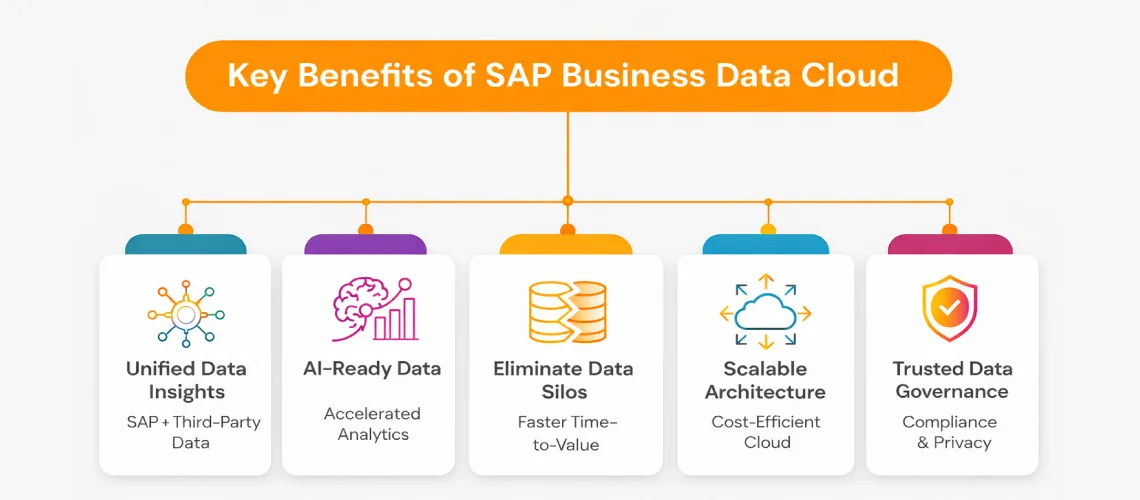
Unified, Real-Time Insights Across SAP + Third-Party Data

One of the biggest benefits that companies can reap is the ability to analyze SAP transactional data alongside non-SAP databases without creating complicated ETL pipelines. The unified access gives decision-makers the ability to view the performance of their operations as well as customer trends and financial metrics all within an integrated analysis environment.

For an instance, manufacturing firms can mix production orders received from SAP together with IoT machine data from other platforms to pinpoint performance bottlenecks in real time. The integration dramatically enhances visibility into operations while reducing manual reconciliation tasks.

AI-Ready Data Foundation & Analytics Acceleration

Because SAP Business Data Cloud maintains semantically aligned and governed data sets that provide a solid base for AI and machine learning projects. Data scientists are able to access business data curated without the need to constantly clean and verify the source tables, which speeds up model development and cuts down on the time required to test models.

In the context of transformation plans this ability is particularly useful as organizations strive to go beyond descriptive reporting to prescriptive and predictive analytics that are integrated right into the business operations.

Reduced Data Silos, Faster Time-to-Value

One of the most frequent issues that is common to huge SAP systems is the presence of multiple reporting systems developed independently over time. Each one has distinct data definitions as well as transformation logic. With the introduction of a central semantic layer and a unified Governance model SAP Business Data Cloud gradually eliminates the silos.

From a rollout standpoint the reductions are usually done incrementally instead of through an innovative big-bang strategy. The first step is to align important domains such as sales or finance analytics, and extend coverage to other aspects once the initial governance models have been vetted.

Cost Efficiency & Scalable Architecture

Although cloud-based platforms are typically assessed on the basis of costs for licensing, the more significant savings typically come from data pipelines that are simplified as well as lower infrastructure maintenance and quicker development times. SAP Business Data Cloud allows companies to increase the size of their analytical workload without continually expanding the hardware on-premise or maintaining separate data marts.

Over the course of the transformation plan, these gains can be seen through a decrease in operational costs and faster implementation of new scenarios for analysis.

Compliance, Data Privacy, & Governance Assurance

The requirement for regulatory compliance is a primary necessity, particularly in sectors like banking and healthcare. SAP Business Data Cloud provides integrated lineage tracking and policy enforcement to ensure that access to data is auditable and is in line with corporate guidelines for governance.

This governance assurance is one reason why many organizations prefer implementing the platform in collaboration with a trusted SAP partner that can align technical configurations with regulatory and operational requirements across regions.

Unlock the Power of SAP Business Data Cloud

Turn fragmented enterprise data into real-time, AI-ready insight with the right SAP architecture and governance strategy.

Industry Use Cases

Manufacturing

Demand Forecasting & Inventory Optimization

In the case of manufacturing, one of the most effective applications is to combine the historical sales data, lead times for suppliers and production capacity measurements to increase the accuracy of forecasting demand. SAP Business Data Cloud enables planners to access these data through a single semantic model, eliminating variations that are common when departments use different planning tools.

Predictive Maintenance Leveraging Historical + Real-Time Data

Another application that is practical can be predictive maintenance. By combining the historical records of maintenance in SAP together with real-time sensor information from equipment on the shop floor maintenance teams can detect patterns that could indicate equipment malfunction. This technique reduces the chance of unplanned downtime and facilitates better spare parts planning.

Supply Chain Visibility & Risk Mitigation

The visibility of supply chain operations is greatly improved when logistics, procurement, and performance of suppliers are examined together. SAP Business Data Cloud helps organizations track delays in supplier deliveries along with transportation disruptions, as well as the imbalances in inventory through integrated dashboards that allow proactive risk mitigation, not reactive firefighting.

Retail

Omnichannel Performance, Customer Behaviour Analytics

Retail companies operate through physical stores, ecommerce platforms, market channels, and physical stores. SAP Business Data Cloud provides a comprehensive overview of customer behaviour, sales and effectiveness of promotion across all these channels. This view combines marketing and merchandising teams analyze performance in a holistic way instead of relying solely on disparate reports.

Personalisation & Real-Time Promotions

When you combine transactional purchase history along with data on customer interactions retailers can create personalized marketing campaigns and promotions that are targeted. The foundation for data governance guarantees that personalized initiatives are based on accurate and consistent customer profiles, rather than isolated snapshots of data.

Inventory / Stock Optimisation Across Channels

The optimization of stock is yet another area where unified analytics provide benefits. Real-time information on demand at the store level inventory, warehouse inventory, and supply lead times enable retailers to manage inventory across channels more efficiently which reduces stockouts as well as overstocking situations.

Finance / Banking

Risk Management & Fraud Detection

In banking environments, risk analysis requires combining transactional data with external market indicators and behavioural patterns. SAP Business Data Cloud supports such integration while maintaining strict governance controls. Risk teams can build advanced fraud detection models using consistent, trusted datasets without compromising regulatory compliance.

Regulatory Reporting with Trusted Data Lineage

The regulatory reporting process often requires a transparent data lineage in order to show the source of figures reported. Lineage tracking capabilities on the platform enable auditors to trace their metrics back to their original source systems, which facilitates review of compliance and cuts down on the manual reconciliation process.

Financial Planning & Forecasting with ML & AI

The financial planners benefit greatly from forecasting models integrated which combine historic financial data and operational indicators, such as trends in sales or constraints on supply chain. Machine learning models are able to produce more precise forecasts, which can aid in the strategic planning process and scenario planning.

Other Sectors (e.g. Healthcare, Energy)

In the field of healthcare, SAP Business Data Cloud can combine the patient administration data as well as clinical records and operational performance indicators to assist with budgeting and optimization of costs. In the energy industry it is able to integrate grid performance metrics, as well as external demand signals to improve distribution and forecast the maintenance requirements of vital infrastructure.

Challenges & Best Practices for Adoption
Challenges & Best Practices for Adoption

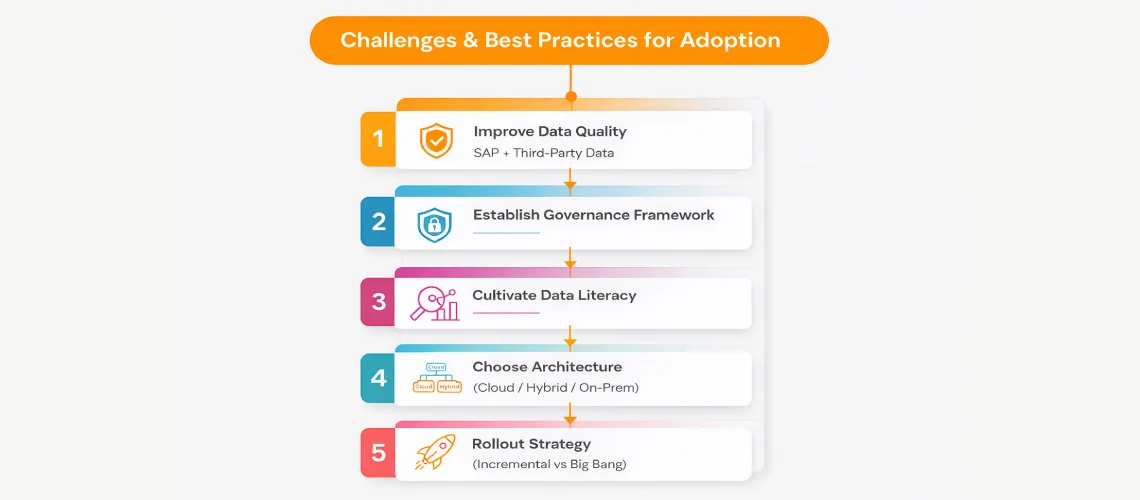
Organisational Culture & Data Literacy

Technology adoption alone does not guarantee value realization. Companies must foster the ability of business users to use data to ensure that data-driven insights are correctly interpreted and incorporated into everyday decision-making. Change management and training initiatives are, therefore, essential elements for every SAP Business Data Cloud rollout.

Data Quality & Integration Challenges

Data integration is one of the most difficult challenges to solve especially in the case of legacy systems that have inconsistencies in master data or custom-built enhancements. Before exposing the data to models for analysis cleaning and harmonization processes should be carried out. In a lot of cases we suggest starting with a specific data area like sales or finance to help stabilize the integration patterns prior to expanding further.

Managing Governance, Privacy, Security

Although SAP Business Data Cloud provides the ability to manage your data, businesses should still establish clear the data’s ownership model, rules for classification and access rules. These governance-related decisions must involve both IT and business stakeholder to ensure that security measures don’t hamper legitimate use cases for analytics.

Choosing between Cloud, Hybrid, On-Premise components

The deployment decisions are heavily influenced by the existing landscape of systems and regulations. Some companies opt for an entirely cloud-based system and others use hybrid configurations in which sensitive data is kept on-premise while analytical applications are run on the cloud. Evaluating these options requires a careful assessment of latency, compliance, and cost considerations, often supported by experienced SAP Migration services teams who understand the technical and operational implications of each approach.

Incremental vs Big-Bang Rollout Strategies

From a purely implementation standpoint from a practical standpoint, incremental rollout strategies typically have better results in terms of adoption as opposed to big-bang implementations. Beginning with a pilot domain allows teams to test data models, governance guidelines and patterns of user adoption before expanding to more business divisions. This method of phasing down risk reduces risk and is consistent with the reality that data landscapes in enterprises evolve slowly rather than in abrupt changes.

Conclusion

SAP Business Data Cloud represents a practical evolution in how enterprises manage and analyze data across complex, hybrid SAP landscapes. Instead of re-inventing existing systems, it offers an governed semantic layer that connects SAP and non-SAP data, providing immediate insights advanced analytics, advanced insights, and AI-driven decision-making assistance.

For organizations already running SAP ERP or planning broader transformation initiatives, understanding what is SAP Business Data Cloud becomes essential to designing a scalable and future-ready data architecture. With unification of governance, flexibility in integration with sophisticated analytics, this platform can help companies move towards data-driven processes while maintaining the security and control required in critical environments.

Profile

Muralidharan Venkataraman

Global Head Delivery & Presales

Copy link

30+ years of experience managing large, complex SAP programs across industries, geographies, and functions. Expert in enterprise-scale transformation and program governance.


Overview of SAP S/4HANA Modules throughout Lines of Business

Overview of SAP S/4HANA Modules throughout Lines of Business

SAP ERP

Published: January 5, 2026

Banner

If you step back and look at why ERP systems exist in the first place, the answer is fairly simple. Different teams inside a company need to work with the same information. Finance cannot close the books properly if sales data sits somewhere else. Procurement decisions depend on production demand. Leadership teams need a clear view of the entire organization, not isolated pieces of it.

Earlier ERP platforms tried to solve this problem, and to be fair, they did connect many of these processes. The problem was speed and complexity. Data often moved through multiple layers before it became usable for reporting. Many organizations ended up running operational systems in one place and analytical reporting somewhere else.

That gap is one of the reasons the enterprise SAP S/4HANA platform was introduced.

Instead of relying on the traditional databases the system is based with the HANA In-Memory Platform of SAP. In real terms, it alters the speed at which data is processed. Transactions and analytics are no longer separated the way they used to be. A finance team looking at revenue figures, for example, is often seeing the numbers almost as soon as they are generated.

But technology alone does not tell the full story.

SAP structures the platform around modules that align with different parts of the business. Finance has its own functional scope. Manufacturing has another. Supply chain, sales, human resources, and engineering each have their own operational areas as well.

Together these pieces form the SAP S/4HANA modules structure. Each module focuses on a specific process but still operates within the same system and the same data foundation.

In most real implementation programs, companies do not switch everything on at once. They usually start where the business impact is the clearest. Finance is a common starting point. Manufacturing organizations might focus on production planning and supply chain coordination first. It really depends on where the current systems are creating the most friction.

The sections below walk through the main modules across different lines of business and explain how they typically fit into enterprise ERP environments.

What is SAP S/4HANA?

Before getting into the module structure, it helps to understand What is SAP S/4HANA and what it actually represents.

The platform is SAP’s current generation ERP suite and is designed to replace the earlier SAP ECC environment that many organizations have used for years. While ECC supported a wide range of business processes, its architecture reflected the database technologies that were common when it was first developed.

S/4HANA moves away from that older model.

Since it is based in conjunction with its SAP HANA in-memory database, the system is able to process massive datasets directly in memory. That eliminates many of the intermediate steps older ERP systems required for reporting. Instead of moving data into separate structures just to generate reports, the system can perform calculations on the transactional data itself.

Another noticeable change appears on the user side. The platform introduces the SAP Fiori interface, which replaces many traditional SAP screens with role-based applications. Instead of having to navigate through a long list of transactions, users connect through apps that focus on their everyday tasks.

Deployment flexibility is another aspect organizations consider. S/4HANA can run on-premises, through SAP S/4HANA public cloud deployment, or within a private cloud SAP S/4HANA deployment, depending on operational requirements and governance policies. Many enterprises also operate hybrid landscapes that combine these approaches to balance scalability, control, and regulatory needs..

Despite these changes, the goal remains familiar. ERP systems still exist to connect business processes. Finance, sales, procurement, manufacturing, and HR all operate within the same environment. The difference is that the system can now handle that coordination with far fewer technical limitations.

What are SAP S/4HANA Modules in the Lines of Businesses?

Within S/4HANA, SAP organizes functionality around what it calls lines of business. Each of these represents a major operational area inside an organization.

Finance, manufacturing, sales, supply chain, human resources, and product development are the most common examples. Inside each of these areas sit modules that handle specific business processes.

This structure is what makes the SAP s 4hana modules list flexible. An organization does not have to install every module in order to begin reaping the benefits of the system. Most organizations start with the most important areas and gradually broaden the scope after the foundation is solid.

It is important that each module works on the same data model. Even if different teams use different modules, the information they generate remains connected across the ERP environment.

The following sections look at how these modules align with different business functions.

Finance (FI)

In most ERP transformation programs, finance tends to be the first area that organizations focus on. That is partly because financial reporting affects every part of the business.

The Finance module, commonly known as FI, manages the core accounting activities within the system. This includes general ledger accounting, accounts payable, accounts receivable, and the financial closing process, which together form the foundation of financial operations in SAP S/4HANA. A more detailed explanation of how these processes work in practice can be found in this overview of financial processes in SAP S/4HANA.

One structural change introduced with S/4HANA is the Universal Journal. Instead of storing financial and controlling data across multiple tables, the system combines them into a single structure. For finance teams, this simplifies reporting quite a bit.

The Controlling module, usually referred to as CO, works alongside FI. It focuses more on internal financial analysis. Cost center accounting, profitability analysis, and internal cost tracking are handled here.

Together, these two modules form the financial backbone of the platform.

For many organizations, improvements in reporting speed and transparency make finance modernization the logical starting point for SAP ECC to S/4HANA migration initiatives.

Manufacturing

Manufacturing environments rarely run in isolation. Everything is connected. If one activity slows down—even slightly—it tends to ripple across the entire production chain. Materials arriving late affect production schedules. Production delays impact delivery commitments. Procurement then has to react, often at the last minute.

That’s where ERP coordination becomes critical, and this is exactly the type of operational alignment systems like SAP S/4HANA were designed to handle.

Within S/4HANA, Production Planning (PP) carries most of the responsibility for manufacturing planning. It covers material requirements planning, production scheduling, and the management of production orders.

In practice, this module answers the kinds of questions plant planners deal with every day.
Do we actually have enough raw material for the production run scheduled next week?
Will the machines be available when a sudden large order comes in?
And more importantly—can the plant deliver on time without creating bottlenecks further down the line?

Because PP connects directly with procurement and inventory data, planners are no longer working with fragmented information. They perceive the situation in its current form rather than as it was yesterday.

Quality Management (QM) is an important function in manufacturing processes. This module is focused on the planning of inspections, tracking defects and monitoring compliance across the lifecycle of production.

In industries like pharmaceuticals or manufacturing for automobiles, high-quality processes aren’t just a matter of best practice, they’re required. Audits for compliance, regulatory audits and traceability requirements require well-organized systems.

When these manufacturing-related modules are implemented properly, information begins to move naturally across departments. A confirmed sales order can trigger production planning automatically. Inventory records update as materials move through the plant floor. Finance immediately sees the cost implications.

That level of coordination is precisely what ERP systems were originally meant to deliver.

Sales

The sales function inside an ERP system has a straightforward goal: convert customer demand into revenue while keeping the rest of the business informed about what’s coming.

The module responsible for this is Sales and Distribution, commonly referred to as SD.

It manages the entire lifecycle of a customer transaction. A process that often begins with a simple product inquiry eventually moves through quotation management, order creation, delivery coordination, and billing.

What makes the architecture of SAP S/4HANA particularly useful is how quickly these events become visible across the system.

The moment a sales order is created, several other areas are affected.

Finance immediately sees projected revenue.
Inventory teams can verify product availability.
Production planners can determine whether additional manufacturing capacity will be required.

In older ERP landscapes, information often moved slowly through multiple reporting layers. Sales entered an order, but other departments might not see the full impact until hours—or sometimes days—later.

That lag diSAPpears when the system operates on a unified dataset.

Many organizations also connect the SD module with analytics tools or customer experience platforms. It also provides a better understanding into purchasing behavior and customer trends. This helps sales professionals forecast the needs of their customers and manage their pipelines more efficiently.

Supply Chain

If you’ve spent any time around ERP projects, you already know this: supply chain is where everything converges. Procurement, manufacturing, warehousing, logistics — they all meet here. When there is a problem in this field the problem is not always confined to one area. The ripple typically spreads to the finance and planning departments as well as the delivery of services to customers pretty quickly.

Inside SAP S/4HANA, Materials Management (MM) handles most of the procurement-heavy lifting. Purchase orders, records of suppliers invoices, receipts for goods, validation, everything that is part of the standard procurement cycle is here.

On paper those activities sound routine. In reality, they’re the gears that keep the entire operational engine moving.

Procurement teams, for example, don’t just “place orders.” They rely on demand signals coming from production planning and inventory levels. If the planning data is wrong, procurement decisions will be wrong too. And that’s exactly why integrated ERP matters.

When these systems are wired together properly, things start working the way they should. Inventory updates the moment goods arrive. Production planners instantly see whether materials are available. Finance receives cost postings automatically without someone manually reconciling spreadsheets at month-end.

Companies running large distribution networks often go a step further by adding tools like SAP Extended Warehouse Management (EWM) and SAP Transportation Management (TM).

Those systems coordinate warehouse activity, optimize shipping routes, and help logistics teams manage freight movements across regions. Once a company starts shipping products across multiple countries or large distribution hubs, that kind of visibility stops being a luxury — it becomes operationally necessary.

And that’s typically where these capabilities show up in most SAP S/4HANA modules implementations.

Human Resources (HR)

HR has been part of ERP systems for decades, even though it sometimes sits slightly outside the spotlight compared to finance or supply chain.

Think about it. Employee records, payroll calculations, leave tracking, workforce planning — all of that needs structured systems. Spreadsheets don’t survive long once a company reaches scale.

Older SAP environments handled this primarily through the SAP HCM module. With SAP S/4HANA, many organizations now combine ERP capabilities with SuccessFactors, which focuses more on the broader employee lifecycle — recruiting, learning, performance management, and employee engagement.

Even when HR tools run in the cloud, integration with the ERP core still matters.

Payroll costs need to flow into financial systems. Workforce planning affects budgeting. Project staffing affects cost allocation. Without those connections, organizations would end up maintaining parallel financial records for workforce expenses — which defeats the whole purpose of running an integrated ERP platform.

When HR data flows properly into finance and planning systems, leadership teams get something valuable: a much clearer view of workforce costs, productivity trends, and long-term hiring needs.

And that visibility is increasingly becoming part of how organizations evaluate the broader SAP s 4hana modules list when modernizing their ERP environments.

R&D / Engineering

For companies that design and manufacture products, engineering teams need close coordination with the rest of the business.

Products Lifecycle Management (PLM) features in S/4HANA allow you to manage the design of products, changes to engineering and compliance requirements throughout the entire lifecycle of an item.

This is particularly relevant when designs change. Engineers are able to alter specifications while developing or after production has begun. These changes should be reflected in manufacturing processes, procurement and quality inspections.

Without a centralized system, communication between engineering and production can quickly become inconsistent.

Industries like aerospace, automotive, as well as consumer electronics heavily depend in this kind of integration. The new designs should be reviewed not just from a technical standpoint, but also from a manufacturing as well as supply chain perspective.

PLM helps keep those discussions grounded in shared data.

Asset Management

Some industries rely heavily on physical equipment. Manufacturing plants, utilities, and energy companies all fall into this category.

For them, asset reliability is just as important as financial performance.

Enterprise Asset Management within SAP S/4HANA helps organizations track equipment lifecycles, maintenance schedules, and service history.

This Plant Maintenance component helps with the planning of preventive maintenance. Instead of waiting around for the equipment to fail, companies can schedule maintenance programs according to the patterns of use or operating times.

This approach over time can reduce unexpected downtime and prolong the lifespan of costly assets.

Some companies also integrate the data from assets with analytics platforms to investigate possibilities for predictive maintenance. In these situations, performance data from equipment can be a sign of potential issues prior to them cause interruptions in operation.

Other Important Modules

In addition to the primary areas of operation, S/4HANA includes several additional modules to support cross-functional operation.

Project System (PS) manages large-scale projects, such as infrastructure development, engineering initiatives or IT software. It includes tools for planning budgets, resource management and project monitoring.

Environmental Health and Safety (EHS) assists organizations in tracking the compliance of their regulations as well as workplace safety incidents and the environmental impact.

Technical modules like SAP BASIS and ABAP offer the platform’s underlying solutions and customizable capabilities which support the whole ERP environment.

These components might not be readily accessible to business users but they are crucial to ensure system performance and for allowing customization.

Find the Right SAP S/4HANA Modules for Your Business

Explore how the right combination of SAP S/4HANA modules can streamline operations across finance, supply chain, and manufacturing.

Benefits of SAP S/4HANA Migration

The migration to S/4HANA has many benefits beyond simply updating ERP technology.

One of the most important enhancements is the real-time analytics. Since S/4HANA handles information in the memory of the system, businesses can create reports directly based on transactional information and without having to rely on distinct data warehouses.

Another major benefit of SAP S/4HANA is simplified system architecture. Elimination of duplicate tables and aggregates lowers the complexity of the system as well as improving performance.

Efficiency in operation is a key benefit. Integrated modules enable different departments to share the same data that reduces manual reconciliation, as well as increasing collaboration.

The platform also provides an infrastructure for the development of new technologies like AI, Advanced Analytics as well as process automation. These capabilities allow organizations to modernize business processes and maintain the security and reliability that is expected of the most reliable enterprise ERP systems.

Best Partner for SAP S/4HANA Modules Implementation

Implementing ERP modules across an enterprise is rarely a straightforward project. Each organization has unique processes, legacy systems, and compliance requirements that must be considered during system design.

This is why many companies choose to work with an enterprise SAP transformation partner that understands both the technology and the operational realities of enterprise environments.

A knowledgeable partner can help companies define the scope of their modules as well as design integration architectures and manage complicated tasks for data migration. They can also guide you on strategies for deployment, including Greenfield deployments, conversion of systems and selective landscape transforms.

Accely, an experienced platinum SAP Gold Partner has aided in many ERP transformation initiatives across different industries. Over two decades of experience in implementation their consultants help businesses navigate the organizational and technical hurdles that arise in large ERP programs.

Start Your SAP ECC to S/4HANA Migration Journey

Move from legacy ERP to SAP S/4HANA with a structured migration strategy designed for scalability and real-time operations.

Conclusion

Understanding the structure of SAP S/4HANA modules is essential for any organization planning to implement or upgrade its ERP environment.

Each module represents a particular business process, from manufacturing and finance to supply chain, sales and HR. Together, they form an integrated platform that lets operations processes and data analysis are integrated into a single structure.

But success in adoption is more than simply activating the modules. The organizations must be careful to match the selection of modules to the business goals, integration requirements and long-term technology strategies.

If properly implemented when it is implemented with care, the S/4HANA platform offers the foundation needed for real-time operations, integrated operations and innovation in the enterprise.

Frequently asked questions

What are the most important SAP S/4HANA modules? +

The core modules in SAP S/4HANA typically include Finance (FI), Controlling (CO), Sales and Distribution (SD), Materials Management (MM), Production Planning (PP), and Human Capital Management (HCM). Together, these modules support essential business functions such as financial management, procurement, manufacturing operations, and workforce administration across the enterprise.

What is the difference between SAP ECC and SAP S/4HANA modules? +

The main difference between SAP ECC and SAP S/4HANA modules lies in the underlying technology. S/4HANA operates on the SAP HANA in-memory database, enabling real-time data processing, simplified data structures, and embedded analytics. ECC, in contrast, relies on traditional databases and often processes large datasets in batches.

Which SAP S/4HANA module is most important for financial management? +

The Finance (FI) module in SAP S/4HANA plays a central role in managing financial operations. It supports activities such as general ledger accounting, accounts payable and receivable, financial reporting, and regulatory compliance. Many organizations prioritize this module because it provides real-time financial visibility and helps streamline the closing process.

How do SAP S/4HANA modules support digital transformation? +

Modules within SAP S/4HANA help organizations modernize operations by connecting business processes across departments. Real-time analytics, automation capabilities, and integration with cloud technologies allow companies to make faster decisions, improve operational efficiency, and adapt more easily to changing business demands.

How do finance modules in SAP S/4HANA help with regulatory compliance? +

Finance capabilities in SAP S/4HANA provide accurate financial reporting and real-time visibility into transactions. These features help organizations maintain consistent records, meet regulatory requirements, and simplify audit processes through transparent and well-structured financial data.

Profile

Vikas Chopra

Practice Head SAP S/4HANA

Copy link

SAP Solution Architect with 23+ years in logistics and SCM. Expert in SAP S/4HANA with hands-on experience in global rollouts, upgrades, and enterprise solution delivery.

Let's talk

Have questions? Reach out, we're just a message away.

Connect with us
Let's connect

If you are looking for a reliable SAP Global Strategic Supplier or Technology Partner, simply fill out the form below and we'll be in touch.


    By clicking Submit, you agree to Accely's privacy policy and terms of use.