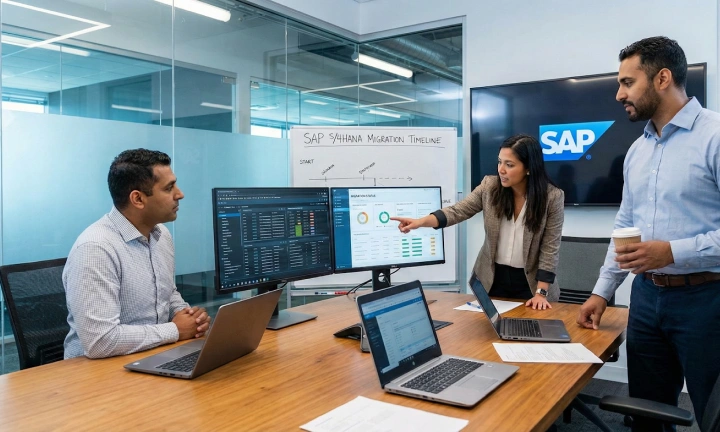
ERP solutions must change from being simply transactional to serving as the basis for creating modern businesses due to the constantly evolving digital economy and environment. Organizations must change their business models, operations, and procedures to meet the growing needs of their businesses as they embrace digital technologies. They need to update their ERP.
You will find out about the various techniques for creating your ERP migration plan to SAP S/4HANA in this blog.
With automation, data model simplicity, and process standardization, SAP S/4HANA is a modular ERP from SAP that helps an organization become an intelligent enterprise.
It is important to assess the adoption of S/4HANA immediately, even if SAP has committed to mainstream support for the ECC application through 2027. You need to figure out the strategic and logistical costs of delays as well as the lost chances for corporate advancement. The implementation of new generation ERP solutions, such as S/4HANA, is more a question of when than why, as the core ERP will soon be digitized.
Greenfield SAP S/4 Hana Migration Strategy
The Greenfield approach functions as a reboot. A company’s SAP operations and business processes are completely reorganized from the old version to the new version as part of the Greenfield migration approach.
Advantages of Greenfield SAP S/4HANA Migration
The Greenfield SAP S/4HANA migration means going by the so-called “from scratch” way whereby the system is the lot for a redesign of the processes, therefore, making it possible to get rid of the old complexity and to harness entirely the power of SAP’s next-generation ERP. This is the ideal case for those companies that want a total transformation instead of a gradual change. Here are the main benefits of the Greenfield path choice.
Clean Slate
The Greenfield migration gives the option of a new beginning devoid of the unproductive adjustments, the technological debts, and the inefficient setups which frequently are the limitations of the old SAP systems. The companies can recreate their environment relying on the best practices as well as the modern business needs currently, without having to take over the unnecessary processes. The building-block method guarantees a simplified base that is going to be less complicated to support and modify throughout the years.
Process Optimization
The Greenfield way leads to the process re-engineering and the optimization of the core business processes the whole way through. Instead of just copying existing workflows, teams are free to have the model of SAP S/4HANA’s process which is the standard, and more aligned with the industry, this translates into productivity and higher process maturity. This process reduction very often brings to the improvement in the operational performance, shorter cycle times, and less dependency on the custom developments.
Flexibility and Scalability
When a brand new system architecture is created, the companies concerned turn into having more flexibility and scalability which will be further supported by their future growth. A Greenfield migration—whether it is expansion into new markets, business units being added, or new technology being integrated—gives the necessary flexibility to the evolving company without having to be restricted by the previous systems. This makes it even more appealing to companies that have large-scale digital transformation visions.
Future-Proofing
Greenfield migration is a big step that companies can take to make sure their IT landscape is in line with SAP’s future innovation plans, thus, really “future-proofing” IT. There will be a clean, modern architecture, and the SAP best practices would be followed which is why the companies would be in a better position to make use of future advancements, cloud services, and intelligent tech like AI, automation, IoT, and advanced analytics. And this will definitely keep the solution applicable and competitive as the business needs change.
Disadvantages of Greenfield SAP S/4HANA Migration
Although the Greenfield SAP S/4HANA migration provides an opportunity for a new beginning and change, it also presents difficulties which organizations need to thoroughly consider. This approach necessitates the development of the whole system afresh and, therefore, very often requires more time, money, and commitment from the organization compared to other migration options. The greatest negatives are listed below.
High Cost: The Greenfield SAP Migration method is the most costly one among the rest.
Longer Implementation Timeline: The implementation time in large companies is much longer than that of Brownfield or Hybrid implementation.
Significant Change Management: It is necessary to apply very good management to the big transition to the new version. One of the reasons is that the employees might not be very eager to give up their old habits and take the new changes in.
Data Migration Complexity: Moving data to a new system requires a very heavy and long process of cleansing and mapping, thus making the migration longer and more difficult.
Risk of Business Disruption: A complete reimplementation also means higher chances of operational interruptions, especially if the redesign of the processes and the user adoption are not taken care of properly.
Why Choose Greenfield?
Deciding on a Greenfield approach gives organizations the opportunity to carry out a comprehensive digital transformation by redoing their ERP landscape free of any restrictions caused by the old systems. It allows organizations to redefine their workflows, switch to the best-practice frameworks, and take full advantage of the smart features of SAP S/4HANA. Greenfield is a strategy for companies that are looking for modernization, flexibility, and long-term scalability to access the full value of the next-generation ERP system.
Opportunity for Simplification: Greenfield allows companies to get rid of the old systems’ complexity and to create a new process designed for a more straightforward and effective system landscape.
Adoption of Innovation: The new beginning allows the staff to fully utilize the features of SAP S/4HANA, its intelligent technologies, and its continuous innovation roadmap.
Future-Proofing: A business is able to undergo new upgrades, and cloud capabilities, and even meet the changing requirements of the industry with ease thanks to its new modern architecture.
Standardization: Greenfield advocates the implementation of SAP’s optimized, standardized processes, which in turn lowers the chances of customizing and helps the business to operate in a consistent and reliable manner.
Potential Challenges
Migration to SAP S/4HANA via Greenfield is a strong basis for transformation but it also brings with it a set of challenges that the organization has to carefully plan for. Such issues usually have an effect on the timeframes, budgets, and the overall success of the project.
Time and Effort: A complete reimplementation of the system will of course take a long time and a lot of resources since you will have to go through the whole process of designing and building everything from the ground up.
Cost: Greenfield migrations require high initial investments in general because of the need for elaborate planning, development, testing, and staff training.
Data Migration Complexity: The process of transferring data into a new system requires a thorough cleansing, mapping and validation which makes it quite complex and resource-heavy.
Change Management: Since Greenfield alters the processes already in place from start to finish, companies will have to deal with user adoption in a very active manner so as not to encounter resistance or disruption to operations.
Brownfield SAP S/4 HANA Migration Strategy
The Brownfield migration option for SAP S/4HANA is the ideal choice for companies that wish to update their ERP landscape but are not yet prepared for a complete system overhaul. The Greenfield strategy involves building the whole system from scratch, while the Brownfield one is a system conversion or upgrade that retains existing SAP ECC settings, custom developments and proven business processes.
Through Brownfield, firms go to SAP S/4HANA by making use of the base they have already acquired—keeping historical data, process flows, and custom code that are still beneficial to the business. This approach gives the opportunity to the companies to enjoy real-time analytics, enhanced performance, and user-friendly interface of SAP S/4HANA without the extra time and cost of a complete reimplementation.
The Brownfield method is characterized by less disruption and is thus particularly appropriate for companies with established, mature processes, extensive customizations they want to keep, or limited resources for change management. It offers a less risky and more predictable path to S/4HANA, supporting organizations in attaining modernization quicker and with lower risk.
Advantages of Brownfield SAP S/4HANA Migration
Brownfield SAP S/4HANA migration presents a solution to the organizations that want to perform the transition from the SAP ECC environment to SAP S/4HANA, keeping the core processes, configurations, and historical data as well. This method works best for the companies that want to modernize the ERP landscape without a full redesign. Brownfield gives a way of moderate difficulty, keeping the good parts and getting the rest from the SAP S/4HANA.
Faster Implementation: The Brownfield techniques for implementation consume very little time compared to the Greenfield method.
Lower Costs: This method is considered to be the cheapest way of implementing SAP S/4HANA completely.
Business Continuity: Since most of the existing processes are to a large extent in Brownfield implementation, there would not be significant impact on end-users and company transitions.
Leverages Existing Investments: Migration by Brownfield ensures that existing configurations, customizations, and data are soil and thereby organizations still enjoying the benefits coming from past investments in ERP.
Simplified Training: Users can require less training and be quickly adapted to the upgraded environment as many processes and system behaviors are the same as before.
Reduced Risk: By transferring the proven workflows and system structures, Brownfield minimizes the risk of operational downtime.
Disadvantages of Brownfield SAP S/4HANA Migration
Even though the Brownfield migration provides a quicker and less bothersome route to SAP S/4HANA, it also bears the brunt of the limitations. Since this method is an upgrade rather than a rebuild, companies may not realize the full potential of deeper transformation, process redesign, and long-term optimization. Hereafter, the main drawbacks are given to you for consideration.
Limited Innovation
Keeping traditional practices and customizations can limit the organization’s adoption of SAP S/4HANA’s contemporary features and the use of modern techniques.
Carries Forward Inefficiencies
The migration may lead to the persistence of existing bottlenecks and outdated workflows, which will in turn lessen the overall value obtained from the migration.
Potential for Technical Issues
The transfer of old customizations, add-ons, and data structures is a step that raises the chances of encountering compatibility issues both during and after the upgrade.
Big Bang Approach
A single extensive cutover is usually required for brownfield migration, which if uncarefully planned can bring about the risk of the transition.
Less Flexibility
Since there are no major alterations done to the foundation of the system, organizations cannot redesign their processes or adopt new operating models to a large extent.
Potential for Rollback Challenges
If problems arise after the migration, reversing the changes can be tough because of the intertwined nature of the upgrading of an existing system along with the migration.
Why Choose Brownfield?
The Brownfield route has been favored by companies that plan to move to SAP S/4HANA and at the same time keep their processes, system design, and historical data. This way is especially good for firms that are satisfied with their current processes but would like to make use of the better performance, analytics, and usability of SAP S/4HANA without going through the whole transformation. Brownfield brings about a balanced and pragmatic path that lessens the complexity while at the same time providing considerable modernization.
Lower Cost
Brownfield generally needs less investment as it relies on current configurations and does not involve a complete system redesign.
Reduced Risk
By conserving processes and structures that are already known and thus preserving them, Brownfield reduces the chances of operational difficulties occurring during the transition.
Faster Implementation
The migration will be done quicker than a complete re-implementation of the new system because a lot of the old system functions will be kept.
Minimal Disruption
The end-users will have fewer changes to their processes which means there will be less disruption to their daily activities and the transition will be smoother.
Preserves Historical Data
With the brownfield approach, companies can keep their entire historical dataset without the need to perform data reconstruction or cleansing.
Challenges
The brownfield SAP S/4HANA migration is viewed as a reasonable and efficient upgrade path, but it still introduces certain challenges which would necessitate organizations to prepare. The challenges are usually linked to the necessity to alter the current systems, check compatibility, and ensure that there will be no performance outages in the new environment.
Custom Code Adaptation
The current custom code will probably require a big adjustment in order to be compliant with the SAP S/4HANA framework.
Potential Inefficiencies
The gaps from the old processes and the outdated configurations could be carried over thus not all the modernization benefits being realized.
Thorough Testing
To make sure that all the current processes, integrations, and customizations continue to work as they should after the upgrade, a lot of testing is needed.
Data Migration Complexity
The process of moving a lot of historical data into S/4HANA necessitates careful mapping, validation, and possible cleanup.
Material Number Length
The change in material number length acceptance can lead to problems during the conversion which can need system synchronization and data preparation.
Hybrid SAP S/4 HANA Migration Strategy
A hybrid approach incorporates the characteristics of both the Greenfield and Brownfield SAP S/4 HANA processes.
It is possible to triple your existing data, remove any part of it that is not needed, wear settings and codes, and also migrate it into SAP S4 HANA without any inconvenience. The hybrid migration procedure is simpler, as it gives you the option of changing your settings. On the other hand, data reloading will be necessary, and that is a significant drawback to deal with.
A hybrid strategy can be extremely beneficial if a company wants to implement only minor changes to its new version. This is because many of the elements you created are to be reused and within a shorter time span. It takes only a few hours instead of many days when the new program is running in parallel with the old one.
Key Aspects of a Hybrid Approach
A hybrid SAP S/4HANA migration takes together the advantages of both the Greenfield and Brownfield methods and thereby allows the organization to very much depend on the process of revamping their existing unreliable ones. At the same time, if the businesses upgrade their systems slowly but surely the whole transformation process will still be under their control. The hybrid strategy permits a balanced and flexible, as well as an incremental, pathway to SAP S/4HANA through the combination of the new system design and the selective reuse of existing elements.
Selective Data Transition
Organizations are able to move only the most pertinent data, thus eliminating the leftover unnecessary data and at the same time efficiency and clarity are enhanced.
Phased Implementation
A phased rollout allows for gradual transformation which in turn allows teams to adapt easily while the operations are impacted minimally.
Customization and Innovation
The hybrid method of migration supports the implementation of the latest best practices and smart features along with the existing customizations that are considered to be valuable.
Reduced Risk and Disruption
The Hybrid approach gives continuity coupled with controlled change, thus it lowers migration risks and has the least impact on business operations through minimizing disruptions.
When to Consider a Hybrid Approach
The Hybrid SAP S/4HANA migration is very much suitable for large scale enterprises that want to be modernized and do consider such a thing taking place, centering their efforts on particular areas while still keeping the rest of their operations the same. This method suits a situation where a complete Greenfield transformation is too disruptive, whereas a Brownfield upgrade does not yield sufficient innovation. Hybrid migration finds the perfect middle ground by allowing the process to be targeted redesign, controlled rollout, and efficient reuse of existing system components.
Modernize Specific Areas: Pick Hybrid when total redesign is required for some business functions and others are allowed to operate normally.
Manage Complex Landscapes: A Hybrid approach is perfect for multi-system environments or various business units in a company that require different timelines for their modernization.
Balance Cost and Innovation: Hybrid allows selective transformation so that organizations can apply their innovation only to the most crucial areas while keeping the overall cost under control.
Mitigate Migration Risks: The combination of continuity and phased change in the Hybrid method reduces the risk of disruption and supports a smoother and more controlled transition.
Examples of Hybrid Approaches
Hybrid SAP S/4HANA migration methods give organizations the possibility of selective modernization—upgrading only the parts of their systems which are less important and need new features. These methods help the companies tailor their transformation journey to their needs, thus ensuring that crucial processes get SAP S/4HANA’s advanced capabilities without having to go through the whole system rebuild.
Selective Data Transition
At the same time, the businesses bring only the most necessary or frequently used data sets over to the new SAP S/4HANA system while the old or not-so-important ones remain behind for the purpose of making the new data environment easier to work with.
Golden Client Conversion
By carefully selecting and transferring high-quality configurations, master data and processes into the new system, a curated “golden client” is formed, which not only guarantees quality but also consistency.
Mix and Match
The mixing and matching of Greenfield and Brownfield approaches characterize the use of stable legacy components in conjunction with the redesigning of other areas that need it or even the complete rebuilding of those that need modernization.
Benefits of a Hybrid Approach
A Hybrid SAP S/4HANA migration is a combination of two favorable solutions—keeping valuable pieces of the current system while also making gradual improvements in the areas of the system that have the highest impact. The blended method allows for a gradual transformation, gives more control over project scope, and synchronizes the evolution of technology with the business priorities. Consequently, organizations are not only able to move toward SAP S/4HANA with confidence but also with efficiency and minimum disruption.
Flexibility
With the Hybrid migration, companies are allowed to update their processes, which are specifically selected, while at the same time keeping the stable legacy components, thus giving them more power over the transformation process.
Cost Optimization
By restricting the complete makeover to only the most important areas, companies will be able to cut down on costs while still making use of the advanced features of SAP S/4HANA.
Reduced Risk
The combination of continuity with limited change reduces operational disruptions and consequently lowers risk during migration.
Innovation
The Hybrid approach allows the introduction of modern techniques such as efficient SAP best practices, smart technologies and enhanced workflows without necessarily going through a process of full elimination and new setup.
Faster Time to Value
Through phased updates and selective modernizations, the organizations will be able to start getting the most out of the system sooner, while at the same time being able to change gradually according to their own rhythm.
Challenges of a Hybrid Approach
In the Hybrid SAP S/4HANA migration scenario there are advantages such as flexibility and strategic modernization but there are also some challenges to face. The Hybrid approach comes with the requirement of careful planning, strong coordination, and robust governance to achieve a smooth transition since it combines both the new and existing system elements. The organizations should be ready to deal with both technical and organizational complexities that are the result of managing several migration paths at the same time.
Complexity
Transitioning to a system that is composed of both a new part and an old part creates technical complexities and rigorous architectural planning is needed.
Third-party Tools
Hybrid migrations might need more third-party migration or integration tools, which would entail additional expenses, effort, and coordination difficulties.
Stakeholder Management
Different teams may go through different amounts of changes, thus making it crucial to have very clear communication and alignment present for the organization so that the adoption across it can be smooth.
On-Cloud versus On-Premise SAP S/4 Hana Migration
Choosing between “On-Premise” and “On-Cloud” databases is one of the most important aspects of the migration process.
Everything is managed by the company in On-Premise, including servers, connections, cybersecurity, hardware, and more. Additionally, no extra devices need to be installed in order for the On-cloud database to function. All of your operations are managed by this unified Service Software (SaaS).
The “On-Premise” and “On-Cloud” databases differ in the following important ways:
On-Cloud
- The initial price is low.
- Do not need any additional installations.
- This method is quite fast because it only needs minor adjustments. On-cloud is typically a template solution.
- Less available customization options.
- In control of the customer/service provider or vendor.
- Very high TCO initially.
On-premise
- Initial expenses are relatively higher than On-cloud migration.
- Requires additional expense of installations.
- Takes more time, since real servers are installed, and modifications are also involved.
- More customizable as compared to On-Cloud.
- Highly secure. Ideal for industries with valuable or confidential data like Healthcare/Finance.
- TCO expenses are low in the long run.
Conclusion
Although SAP S4 HANA Migration is a significant investment for any firm, it is now one of the primary goals of administration and management since it is essential to future-proofing the IT landscape. We are all aware that the corporation will eventually need to switch to SAP S/4 HANA in order to keep up with other businesses in terms of technical growth, as the previous version is no longer supported.
Even if there may be a number of challenges on your migration path to the new SAP S/4 HANA, it is crucial to select an appropriate SAP S/4HANA implementation plan for your company.
The best news is that there are several options for effectively migrating to the most recent version of SAP S/4HANA provided you understand the advantages and choose to engage in migration.

SAP Solution Architect with 23+ years in logistics and SCM. Expert in SAP S/4HANA with hands-on experience in global rollouts, upgrades, and enterprise solution delivery.
Explore related blogs
-

SAP S/4 HANA Finance – An Efficient Financial Module Process for All Corporates
SAP S/4 HANA Finance is about simplifying your accounting, improving cash management, and eliminating data replication and data redundancy.
Read more -
Maximize SAP S/4HANA Benefits with Intelligent RPA
RPA or IRPA is being used by businesses to quickly serve the consumers, overhaul their activities to distribute roles, and cut expenses amid these economic turbulences. Visit us to know more!
Read more -
What are the new features and functionalities added in S/4HANA TM?
Latest update of SAP S/4 HANA adds improved dynamics and multiple-level functionality, making it even more appealing for the transportation industry. Visit us to know more!
Read more -
What to know about Design-In Security and Controls in SAP S/4HANA?
While simplifying business processes, the SAP S/4HANA promotes improved performance and more significant business value. Visit our website to know more!
Read more