
SAP launched Business Data Cloud in February 2025, a fully managed SaaS platform sitting on SAP BTP that pulls SAP Datasphere, SAP Analytics Cloud, SAP BW, and SAP Databricks into one governed environment. It hooks into both SAP and non-SAP sources, kills the data silo problem, and runs real-time analytics and AI without copying data around. Everything you need to know about the architecture, what it’s made of, and how to implement it is in this guide.
What Is SAP Business Data Cloud?
Most enterprise data problems aren’t really about data, they’re about disconnection. Finance is running one version of the numbers. Supply chain has another. IT is stuck building pipelines between the two. By the time a decision gets made, half the meeting was spent arguing about whose report is correct.
SAP built Business Data Cloud to fix exactly that. Announced on February 13, 2025, SAP BDC is a fully managed SaaS platform that brings all of your business data, from SAP systems and third-party sources alike, into one governed, connected environment. No manual extractions. No duplicate data lakes. No reconciliation marathons before every board meeting.
It runs on SAP BTP and combines the capabilities of SAP Datasphere, SAP Analytics Cloud, SAP BW, and SAP Databricks under one subscription. The goal is straightforward: give every team in your business access to the same trusted data, with the business context already built in.
For organizations evaluating the platform, SAP Business Data Cloud for enterprises covers the full capability set and how implementation works in practice. If you want a broader.
Before diving into architecture specifics, it helps to have a solid grounding in the platform itself, this breakdown of what SAP Business Data Cloud is and how it works covers that foundation well.
Stat Callout: SAP BDC reduces compliance risk by 30%, increases cross-functional cooperation by 35%, and cuts development cycle time by 40%.
How Does SAP Business Data Cloud Architecture Work?
At its core, SAP BDC architecture follows a layered approach, data comes in from source systems, gets shaped and governed in the middle layers, and surfaces as actionable insights at the top. The concept is straightforward, but the execution is what separates it from anything SAP has previously offered.
How Data Flows From Source Systems to Business Insights
The journey starts in your source systems, SAP S/4HANA, SAP SuccessFactors, third-party CRMs, SQL databases, whatever your business runs on. SAP BDC connects to these, identifies the relevant data entities for a given business scenario, and pulls them into the Foundation Services layer.
From there, the data gets cleansed, transformed, and shaped into what SAP calls “data products”, structured, reusable datasets ready for modeling or direct consumption. These flow into SAP Datasphere for semantic modeling, and then up into SAP Analytics Cloud where business users interact with dashboards, reports, and planning tools.
The entire flow is managed by SAP. You don’t build or maintain the pipelines. That is the point.
The Semantic Layer, How SAP BDC Gives Raw Data Business Meaning
This is where SAP BDC does its most important work. Raw data from your ERP means nothing to a finance director unless it gets translated into terms they recognize, “gross margin,” “days sales outstanding,” “open purchase orders.”
The semantic layer inside SAP Datasphere handles that translation. It maps technical database fields to business definitions that reflect how your teams actually think and work. Once that mapping is in place, everyone pulls from the same dictionary.
That one change alone, everyone agreeing on what the numbers actually mean, tends to cut hours out of planning cycles that used to start with a 20-minute argument about whose spreadsheet is right.
What Is Zero-Copy Data Sharing and Why Does It Matter?
Zero-copy data sharing is simpler than it sounds. Normally when different systems need to use the same data, someone copies it, and the moment you do that, you’ve got two versions of the truth competing with each other. Which one got updated last? Which number is the dashboard showing? Nobody’s quite sure.
BDC sidesteps that entirely. The data stays where it is. Other systems and users get access to it directly, without a copy being made. Governance holds, storage costs stay reasonable, and your AI models are always working from whatever the current state actually is, not a snapshot from last Tuesday’s batch job.
The infrastructure underpinning all of this is SAP BTP consulting and implementation, the platform layer that ties the entire BDC architecture together.
Ready to Build on a Stronger Data Foundation?
See how the right BTP setup can make your entire SAP data architecture more connected, governed, and ready for AI.
Core Components of SAP Business Data Cloud Architecture
SAP Datasphere, Semantic Modeling and Governance
SAP Datasphere is the modeling and governance engine within BDC. It is where data products from Foundation Services get organized into semantic views, business logic gets defined, and access controls get applied.
Think of it as the layer that transforms structured datasets into something a business analyst can use without calling IT every time. Within BDC, the SAP Datasphere architecture is more tightly integrated than when Datasphere operated as a standalone product, it no longer needs to be configured and managed separately, which cuts setup time considerably and removes a layer of operational overhead that earlier implementations required.
SAP Analytics Cloud, Planning, Dashboards, and Insights
SAP Analytics Cloud is the front-end layer where most business users spend their time. Dashboards, financial planning models, scenario simulations, and ad-hoc analysis all run here, fed by governed data flowing through Datasphere.
Most BI tools stop at showing you the data. SAC doesn’t. Because it’s wired directly into the planning engine, a finance analyst can spot something in a dashboard, adjust the forecast, stress-test a scenario, and push an updated plan back into the workflow, without leaving the screen or looping in IT. For the full picture of how the analytics layer supports business decisions, SAP Analytics Cloud for business intelligence covers it in detail.
SAP BW and BW/4HANA, What Happens to Your Legacy Data Warehouse
This is the question every BW customer asks when they first hear about SAP BDC: does moving to this platform mean rebuilding everything from scratch?
The answer is no. SAP BDC supports the technical onboarding of existing BW objects, converting them into consumable data products within the new architecture. Your historical reports, models, and transformations do not get discarded, they get modernized and made available within BDC’s governed environment.
On timelines, SAP BW gets extended support until 2030, and BW/4HANA is where new development should be heading after that. Four years sounds comfortable until you factor in how long implementation projects actually take to get off the ground. Organizations mapping their BW landscape now will have a much smoother transition than the ones who circle back to this in 2028. If you’re also thinking through your broader infrastructure at the same time, your SAP S/4HANA deployment options are worth reviewing in parallel.
SAP Databricks, AI, Machine Learning, and Advanced Analytics
SAP Databricks handles analytical workloads that go beyond standard reporting, machine learning model training, complex data transformations, predictive analytics. Data scientists and engineers work here, building models that feed back into the BDC environment.
The integration runs both ways. Data products can be shared with Databricks for processing and returned to BDC for use in dashboards or planning scenarios. This lets organizations combine SAP’s governed business data with custom AI models without breaking the governance framework that holds everything together.
Foundation Services, Where SAP BDC Data Products Are Created and Stored
Foundation Services is the engine room of the architecture. Running on SAP HANA Cloud with data lake storage for structured and unstructured data at scale, this is where raw source data gets ingested, cleansed, harmonized, and shaped into SAP BDC data products, the core unit of value across the entire platform.
SAP manages all of these operations. Organizations consume the output; they do not manage the underlying infrastructure. This is one of the more significant operational differences between BDC and earlier SAP data management approaches, and it is worth factoring into total cost of ownership comparisons.
SAP BDC Cockpit, The Central Control Interface
The BDC Cockpit is the management dashboard for the entire environment. From here, administrators can browse and install Intelligent Applications, manage data products, share datasets with Databricks, and monitor system health and integration status. It is designed for both technical users and business analysts, a deliberate choice to reduce day-to-day IT dependency for routine data operations.
Key Features of SAP Business Data Cloud
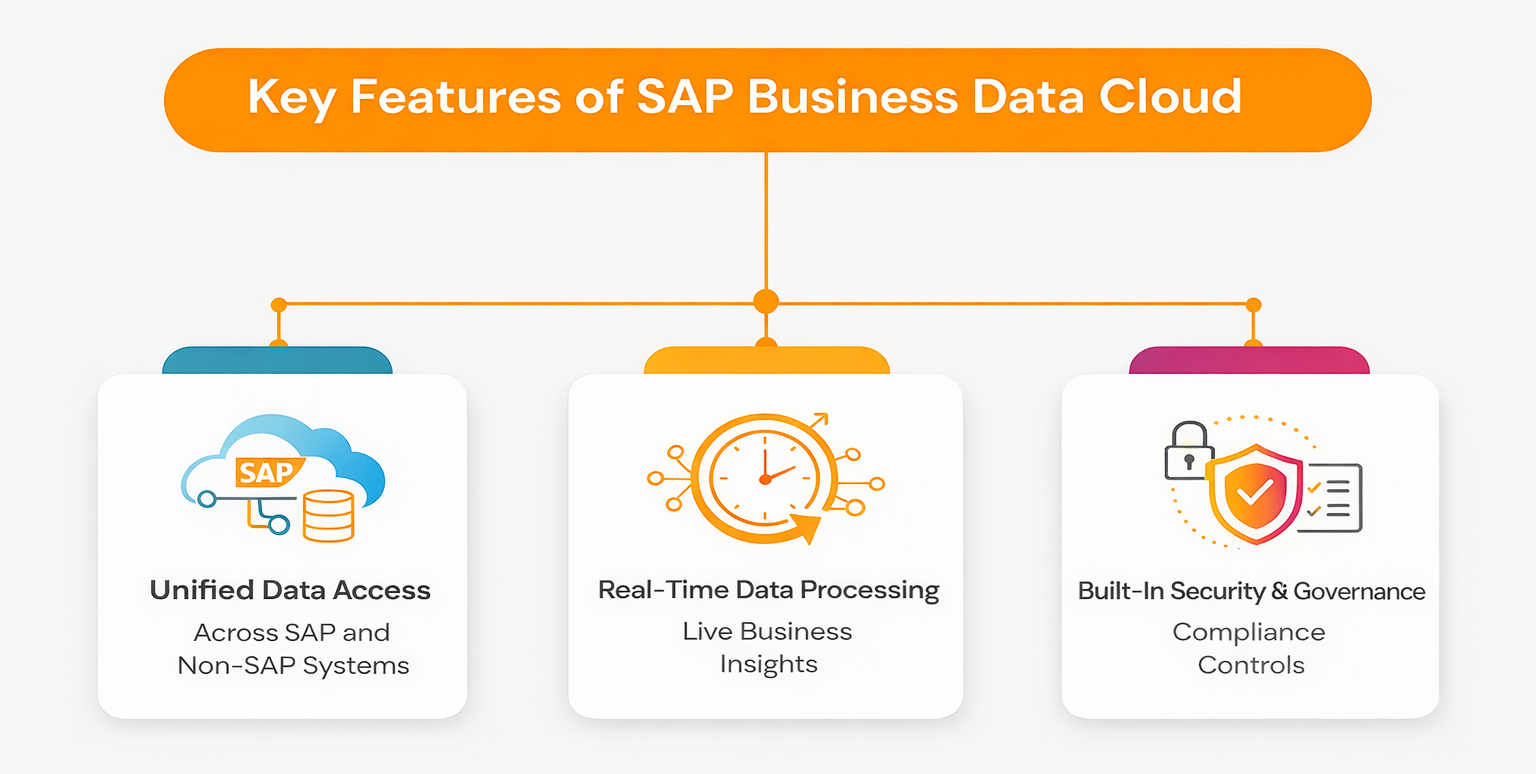
Unified Data Access Across SAP and Non-SAP Systems
SAP BDC isn’t picky about where data lives. SAP S/4HANA, SAP SuccessFactors, Salesforce, SQL databases, external APIs, it connects to all of them. And because access is federated, nothing has to be replicated into a central store before teams can use it. Every team pulls from the same live picture regardless of which system originally owns the data.
Real-Time Data Processing and Live Business Insights
The platform is built for live data access, not batch reporting cycles. When something changes in your source systems, that change reflects in dashboards and planning models without waiting for a nightly refresh. For businesses making time-sensitive decisions, inventory adjustments, pricing calls, headcount planning, this makes a real operational difference that batch-based approaches simply cannot match.
Built-In Security, Governance, and Compliance Controls
Governance in SAP BDC is not added on top of the architecture, it is part of it. Data lineage tracking, role-based access controls, audit trails, compliance monitoring, none of this is bolted on after the fact. It runs through Foundation Services and Datasphere as a core part of how the platform operates. For anyone managing regulated data or operating under strict financial controls, that distinction matters. Understanding SAP Cloud data security and compliance within the BDC context is an important part of any implementation conversation.
What are SAP Intelligent Applications and How Do They Work?
SAP Intelligent Applications are essentially ready-to-run analytics solutions for specific business domains, finance, supply chain, HR. Rather than spending months building data models and dashboards from the ground up, you install an application and get a fully configured environment for that domain out of the box.
Each application has three layers: data products (raw data replicated from source systems on installation), data models (semantic views and business logic defining how that data is structured), and dashboards (interactive planning and insight tools at the front end). SAP manages everything in the background. The time-to-value on these applications is dramatically shorter than custom-built solutions, which is one of the clearest practical advantages BDC holds over earlier platforms.
AI and Machine Learning Built Into the Data Architecture
Because the semantic layer gives AI models proper business context, the outputs are far more actionable than models working on raw database tables. SAP AI Core manages the full AI lifecycle within BDC, and SAP Databricks handles custom model development. The result is AI that explains recommendations in business terms rather than just surfacing statistical correlations that require an analyst to interpret.
SAP Business Data Cloud vs SAP Datasphere, What’s the Difference?
If you’re currently on SAP Datasphere, this is probably the first question you’re asking, and it deserves a straight answer, not a comparison table full of checkmarks.
Stat Callout: SAP Datasphere launched in 2023. SAP Business Data Cloud launched February 2025, building directly on the Datasphere foundation and extending it significantly.
SAP Datasphere was a strong move toward a unified data layer. It brought integration, semantic modeling, and governance onto SAP BTP and gave organizations a meaningful step forward from older data warehouse approaches. But it had real limitations, particularly around aligning business and technical teams on a shared data understanding, and around embedding AI natively into data workflows without additional integration work.
SAP BDC goes further in four specific ways:
- Fully managed SaaS. Datasphere still required more customer-side environment management. BDC removes that overhead entirely.
- One subscription, multiple capabilities. BDC bundles SAP Analytics Cloud, Databricks, and BW elements together. Datasphere was primarily a standalone data layer.
- Intelligent Applications. Pre-built, domain-specific solutions that Datasphere simply did not offer.
- Deeper native AI. Through SAP AI Core and the SAP Knowledge Graph, BDC produces AI outputs with genuine business context already built in.
Existing Datasphere customers are not being pushed to migrate immediately. Both products continue to run, and SAP has confirmed the transition can happen at each customer’s own pace. For new projects and new investments, though, BDC is clearly where SAP is directing its development.
What Business Outcomes Does SAP BDC Actually Deliver?
Features are one thing. What actually changes for the people using this platform every day is the more useful question for organizations doing a real evaluation.
For Finance Teams, Faster Reporting and Real-Time Planning
Finance teams typically spend a significant chunk of the week pulling data from different systems before analysis can even begin. With BDC, that consolidation happens at the architecture level. Finance gets a live, governed view of P&L, cash flow, and cost center data, and can run planning scenarios directly without waiting on IT to prepare data extracts first.
For Supply Chain Teams, Unified Visibility Across Operations
Inventory, procurement, logistics, and demand planning data often sits across multiple systems with no agreed definition of “available stock” or “on-time delivery.” BDC creates that shared definition at the semantic layer and makes it available to every team simultaneously. Decisions that previously required days of cross-functional alignment can happen in a single planning session.
For IT Teams, Reduced Integration Complexity and Cost
Every custom integration between systems is technical debt that someone has to maintain. SAP BDC replaces many of those point-to-point connections with a governed, centralized data layer. IT spends less time keeping pipelines running and more time on work that actually moves the business forward. The fully managed SaaS model reduces infrastructure overhead further, SAP handles the platform, IT focuses on business logic and configuration.
SAP BDC Implementation, What Should You Expect?
Who Should Move to SAP Business Data Cloud and When?
If your teams are deep in the SAP ecosystem and still burning hours every week just getting data into a usable state before any real analysis can happen, BDC solves that at the architecture level, not with more tooling on top. It also makes sense for businesses that want AI embedded in their workflows but have no appetite for building and babysitting the infrastructure that requires.
BW customers need to take the 2030 deadline seriously. That date feels comfortable right now, but implementation projects don’t start the day you decide to move, they start after months of scoping, vendor selection, and procurement. Organizations that kick off the planning conversation in the next 12 months are the ones who’ll have room to do this properly.
How Does SAP BDC Integrate With Your Existing SAP Infrastructure?
On the technical side, SAP S/4HANA Cloud, SAP SuccessFactors, and SAP BW all plug into BDC through connectors that SAP ships out of the box, no custom plumbing needed to get your core SAP systems talking to the platform. Non-SAP sources come in through standard APIs and Databricks’ open ecosystem.
The part that catches teams off guard is data product design. You need to decide which entities from your source systems are worth modeling and, more importantly, make sure the semantic layer reflects how your business actually defines things, not just how the database happens to store them. That thinking takes time and domain knowledge.
Firms that invest in getting it right early move through the rest of implementation quickly. The ones who skip it spend months cleaning up dashboard inconsistencies that should never have been there in the first place.
SAP BDC Implementation Best Practices for 2025
Three things come up repeatedly in implementations that go well:
Resist the urge to connect everything on day one. Seriously, pick one domain, finance consolidation, supply chain visibility, HR reporting, get it working properly, and use that as your foundation. Sprawling scope on a first BDC implementation almost always creates more problems than it solves.
Sort out your semantic definitions before anyone opens a data model. Finance and operations will have subtly different definitions of the same terms, “revenue,” “headcount,” “available inventory”, and those differences need to be resolved in a room, not discovered six months into build when dashboards start contradicting each other.
Get your BW object inventory done before the project formally kicks off. Knowing which objects are actively used, which are relics nobody touches, and which ones genuinely need to come across into BDC will save real budget when the clock starts running.
How Is SAP Business Data Cloud Priced?
SAP BDC uses a Capacity Unit (CU) subscription model. You purchase a set number of CUs and allocate them dynamically across the platform’s capabilities, reporting, planning, data modeling, AI analytics, based on what your teams need at any given point.
Intelligent Applications are not included in the base CU subscription. They are priced separately based on Full-User Equivalents (FUEs) in the connected source system and added on top of your CU commitment.
The flexibility is real, but without upfront capacity planning you will either overpay or run short as usage grows, neither is a great outcome.
Not Sure Where to Start With Your SAP Migration?
Get clarity on your migration path, timelines, and what to expect at every stage before committing to anything.
Conclusion
Here’s the honest take on SAP BDC: the problem it’s solving isn’t new. Fragmented data, misaligned teams, slow reporting cycles, every enterprise has been dealing with this for years. What’s different is that SAP has finally built something that addresses it at the architectural level rather than patching it with another integration layer.
The platform isn’t perfect and it’s still maturing, Intelligent Applications are expanding, the AI capabilities are evolving, and pricing conversations can get complex. But the direction is clear, and organizations that wait for “full maturity” before engaging tend to find themselves two years behind the ones that started learning on real projects.
If you’re in the SAP ecosystem and your data situation is costing you more than it should, in time, in bad decisions, or in IT overhead, BDC is worth an honest look. The starting point matters less than actually starting.
Frequently asked questions
What is SAP Business Data Cloud architecture? +
SAP Business Data Cloud architecture is a layered, cloud-native data platform built on SAP BTP. It connects source systems, SAP and non-SAP, to a Foundation Services layer for data ingestion and product creation, then to SAP Datasphere for semantic modeling and governance, and finally to SAP Analytics Cloud for dashboards, planning, and AI-driven insights. The entire platform is fully managed by SAP under a SaaS subscription model.
What are the core components of SAP BDC? +
The core components are SAP Datasphere (semantic modeling and governance), SAP Analytics Cloud (dashboards and planning), SAP BW/BW4HANA (legacy data warehouse integration and modernization), SAP Databricks (advanced analytics and machine learning), Foundation Services (data ingestion, harmonization, and storage), and the SAP BDC Cockpit (the central management interface for the entire environment).
How is SAP Business Data Cloud different from SAP Datasphere? +
SAP Datasphere is a data modeling and integration layer. SAP BDC builds on top of it and adds SAP Analytics Cloud, SAP Databricks, Intelligent Applications, and native AI capabilities, all under one fully managed SaaS subscription. BDC is the broader platform; Datasphere is one component within it. The key practical difference is that BDC is fully managed by SAP, while Datasphere required more customer-side environment management.
What are SAP Intelligent Applications in SAP BDC? +
SAP Intelligent Applications are pre-built, full-stack analytics solutions that come with data models, business logic, and dashboards already configured for specific domains such as finance, supply chain, and HR. They are installed as complete packages and fully managed by SAP, which significantly reduces time-to-value compared to building custom analytical solutions from scratch.
Is SAP BDC replacing SAP BW? +
Not immediately. SAP BDC supports the migration of existing BW objects into the new architecture, and SAP has committed to supporting legacy SAP BW through 2030. After that, BW/4HANA is the recommended foundation for new development. Organizations currently running legacy SAP BW should begin planning their transition now rather than waiting until the 2030 deadline approaches.

30+ years of experience managing large, complex SAP programs across industries, geographies, and functions. Expert in enterprise-scale transformation and program governance.
Related blogs
-

What is SAP Business Data Cloud: Components, Benefits, & Use Cases
Explore SAP Business Data Cloud components, benefits, and use cases to unify analytics, governance, and AI-ready data across enterprise landscapes.
Read more