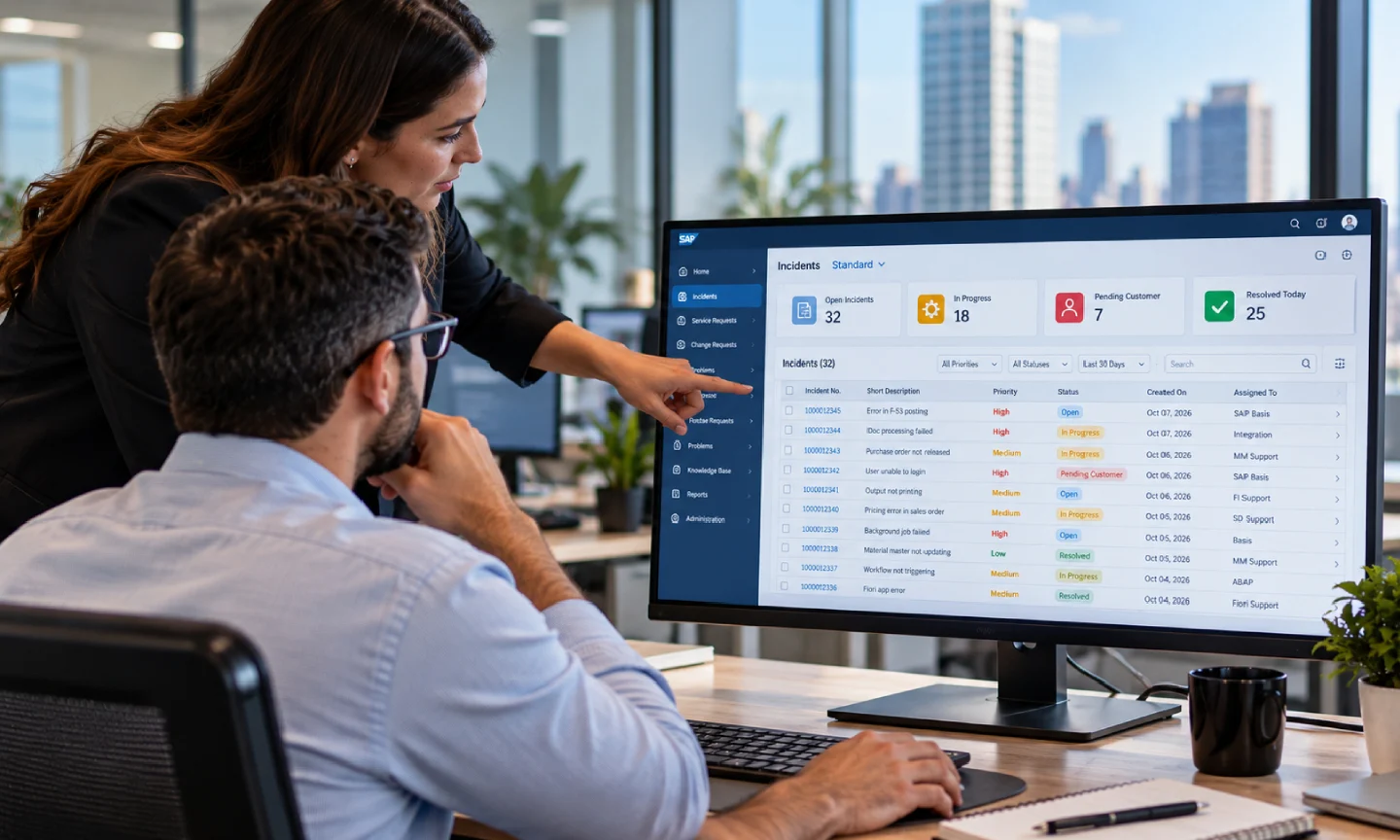
The benefits of SAP AMS aren’t complicated, and nine of them come up again and again. Cost that’s lower and, more to the point, predictable. A full bench of SAP experts without the hiring. Your own people are freed from firefighting. Add better uptime, fewer surprises, tighter security, and a system that keeps improving rather than drifting, and it all rolls up into one thing: more return on the SAP you’ve already paid for. That’s the job AMS does. It turns the messy business of running SAP into a steady service you can plan around.
Here’s the thing nobody tells you before go-live: go-live is the easy part. Once SAP is running, it has to stay running, and stay useful, for a decade or more, patched and fixed and improved as the business shifts around it. That long tail of work is where most of an SAP system’s cost, and most of its value, quietly ends up. AMS is who carries it. The wider market has clearly noticed, one analyst estimate puts the AMS space on track to grow from roughly $17 billion in 2020 to something near $95 billion by 2030. Numbers aside, though, the question most teams care about is the plain one: what do you get for it? Here are the nine benefits of SAP AMS that matter most, and why each one earns its place.
What is SAP AMS?
A quick definition before the benefits, in case you need it. SAP AMS (Application Management Services) is the outsourced, ongoing support and improvement of your SAP landscape, handled by a specialist partner under an SLA. It spans running, maintaining, and improving the system, from incident handling to enhancements. If you want the full breakdown of what’s included, the team roles, and the delivery models, we cover it in SAP AMS Explained. Here, the focus is on why it’s worth having.
The 9 key benefits of SAP AMS
These are the benefits of SAP AMS that show up most often in practice, and the reasons they matter.
1. Predictable, lower total cost
Cost is usually the first reason teams pick up the phone, and it’s a fair one to lead with. Carrying a full SAP team in-house is expensive in ways that don’t show up on a single line. The salaries, yes, but also the benefits, the training, and the awkward stretches where skilled people sit idle between crises. Swap that for a partner and you pay a known figure for an agreed scope. A lumpy fixed cost becomes a predictable variable one, and it tends to come in lower overall, because your provider spreads those specialists across many clients rather than parking them on your payroll waiting for the next fire. Predictable is the real prize here. Cheaper is often a bonus on top.
2. On-tap access to specialized SAP expertise
Hiring and keeping senior SAP talent is hard and expensive, and it’s only getting harder as experienced people retire and demand climbs. AMS hands you a whole bench, functional consultants, ABAP developers, Basis administrators, without you recruiting any of them. Need a rare skill for two weeks? It’s there. The alternative, hiring a full-time specialist you only need occasionally, rarely adds up.
3. Your internal team freed for strategic work
Every hour your sharpest people spend resetting passwords and chasing routine tickets is an hour stolen from work that moves the needle for the business. AMS takes that run-and-maintain load off their desks and hands it to a team whose whole job is exactly that, which leaves your own people free for the architecture, the strategy, and the projects you hired them for in the first place. It’s the benefit almost everyone underrates when they sign up, and rates highest a year in.
4. Higher stability and uptime, backed by SLAs
With AMS, uptime stops being a hope and turns into a commitment. The SLA puts numbers on response and resolution times, and a good provider is measured against them. Fewer outages, faster fixes when something does break, and someone contractually accountable for both. For business-critical SAP, that reliability is worth a lot on its own.
5. Proactive monitoring that prevents issues
The best AMS work is the incident that never happens, the one you never hear about because someone caught it first. A strong provider isn’t sitting around waiting for a user to complain. They’re watching the system, reading the early warning signs, and stepping in while a slowdown is still just a slowdown, before it tips into an outage. That move, from firefighting to prevention, is most of the difference between running SAP well and running it on luck.
6. Scalability and flexible, right-shored delivery
Business demand rises and falls, and your support should be able to move with it. AMS flexes, extra hands for a rollout or a heavy quarter, a lighter touch when things go quiet, none of it involving the pain of hiring and firing. You also get to choose how close the team sits: onshore if you want them in the room, offshore if cost is leading the decision, nearshore or hybrid somewhere in between. And the things that quietly wreck an internal rota, a key person on holiday, a sudden spike in tickets, just get absorbed.
7. Continuous improvement and faster innovation adoption
Good AMS does more than keep the system alive, it keeps making it better. A strong partner is always hunting for what to optimize, automate, or simplify, and helps you take on new SAP capabilities as they land instead of falling behind. In an era where SAP is shipping AI features fast, a partner who helps you put them to use is a real edge.
8. Stronger security and compliance
Your SAP systems sit on some of the most sensitive data you hold, and keeping them secure and compliant never really stops. There’s always another patch to apply, another regulatory change to absorb, another access review or audit trail to keep clean. AMS makes all of that someone’s named responsibility instead of a job that gets squeezed in around everything else. You end up with less risk on the books, and a lot less scrambling the week an audit or a new rule lands.
9. Faster, higher ROI on your SAP investment
Everything above rolls up into this one. An SAP implementation is a serious investment, and its return depends entirely on how well the system runs and improves over the years that follow. AMS protects and grows that return, more uptime, lower running cost, continuous improvement, faster adoption of new value. It’s the difference between an estate that quietly ages and one that keeps paying back. That’s especially true right after a big move like an SAP S/4HANA migration, when the value is all still ahead of you.
How AI is amplifying these benefits in 2026
AI is quietly making good AMS better, and it shows up across most of the benefits already listed. Monitoring has gone from reporting failures to predicting them, which sharpens the prevention side no end. Tickets that arrive get read, ranked, and sent to the right place on their own, so nothing waits around for a human just to triage it. For the issues that keep recurring, the system digs out the fix that worked last time and offers it up, and a growing share of the routine stuff now closes without anyone touching it, which drags resolution times and costs down together. None of this puts the AMS team out of work. It clears the repetitive layer so the experienced people spend their hours where judgement is the point. At Accely, that’s the thinking behind our AI-assisted managed services, built on the same intelligence SAP is baking into the platform through SAP Business AI.
SAP AMS in-house vs outsourced: the honest trade-off
Outsourcing AMS isn’t automatically right, and pretending otherwise helps no one. Keep it in-house and you get the tightest grip on your own processes and the closest line between IT and the people using the system. For a small, steady landscape with a capable team, that can be all you need. The trouble starts when you try to scale it, cover a long absence, or keep an internal team current across a dozen SAP skills you each need about once a year. That’s where an internal setup strains. Outsourcing gives up a sliver of that closeness and buys back flexibility, a much deeper bench, and a cost you can predict, and a decent provider closes the knowledge gap quickly during transition anyway. For most mid-size and large estates, the sums point toward outsourcing or a hybrid. For a lean, stable shop, in-house can still be the better answer. Either way, decide it on the evidence rather than on habit.
How to capture these benefits, not just buy them
Buying AMS doesn’t guarantee the benefits, using it well does. A few things separate the engagements that pay back from the ones that merely answer tickets. Scope it clearly, so everyone knows what’s covered and what isn’t. Pick the right-shored delivery and pricing model for your workload rather than the cheapest quote. Insist on SLAs specific enough to hold someone to. And choose a partner who’s proactive and AI-capable, because one still working reactively by hand in 2026 is charging you for its own inefficiency. We go deeper on this in our guide to getting maximum ROI from SAP AMS support.
Curious what AMS would return for your SAP landscape?
Accely can map these benefits to your systems and show you where the value is.
How Accely helps
Accely runs AMS designed to turn every one of these benefits into something you can put a number against. We’re an SAP Gold Partner going on 26 years, with more than 950 organisations behind us, and we cover the whole landscape, the functional side, the technical and ABAP work, and the Basis layer underneath, whether you’re on S/4HANA, still on ECC, or straddling both. What our SAP application management services do differently is pair proactive, AI-assisted support with senior consultants who own the outcome, so what lands on your side is lower cost, steadier uptime, and a system that keeps getting better. Not a queue that merely gets answered.
Think AI-First. Build What’s Next. Powered by Eerly AI Studio™.
Ready to get more from your SAP investment?
Accely’s AI-assisted AMS keeps your landscape stable, secure, and improving, for a predictable cost.
Conclusion
The benefits of SAP AMS aren’t really about tickets and support hours, they’re about what a well-run SAP estate does for the business: lower and steadier cost, better uptime, a team freed to build rather than firefight, and an investment that keeps paying back. The generic version of AMS answers your queue. The good version makes your SAP systems quietly better, month after month, while costing less to run. That’s the difference worth paying for, and worth choosing a partner carefully to get.
Frequently asked questions
What are the main benefits of SAP AMS? +
Predictable, usually lower cost tends to top most people’s list, closely followed by getting a full bench of SAP skills without hiring anyone. Beyond that: your own team freed up for strategic work, better uptime under an SLA, problems prevented rather than just fixed, support that flexes with demand, steady improvement, tighter security, and a faster return on the SAP you’ve invested in. Add them up and running SAP goes from an unpredictable burden to a service you can plan around.
Does SAP AMS save money? +
Usually, yes, though the bigger win is predictability. Instead of carrying a full in-house team with idle capacity, you pay a known figure for an agreed scope, which converts a fixed cost into a variable one and often lowers it. The savings grow when the provider’s proactive work heads off the expensive outages and rushed contractor bills that reactive support runs into.
Is outsourcing SAP AMS worth it? +
For most mid-size and large estates, it usually is. The flexibility, the deeper bench, and the predictable cost tend to win out over the bit of closeness you give up, and that’s doubly true right now, with experienced SAP people hard to find and pricey to keep. If you’re small and stable with a strong internal team, staying in-house can still be the smart move. It really comes down to your size, how complex your landscape is, and how much the business would hurt if SAP went down.
What’s the difference between in-house and outsourced AMS? +
In-house wins on intimacy, nobody knows your quirks better, but it’s hard to scale and expensive to keep sharp across every skill you touch. Outsourcing gives up a little of that closeness for a deeper bench, easy scaling, and a cost you can budget, and a good provider narrows the knowledge gap fast during handover. In practice a lot of organisations split the difference, keeping the crown-jewel knowledge in-house and handing the rest to a partner.
How do you measure the ROI of SAP AMS? +
Track a few things: what your running cost does, whether uptime improves and incidents drop, how fast issues get resolved, how many internal hours get handed back to higher-value work, and what new capabilities you manage to adopt. The single clearest tell of a healthy engagement is incident volume falling over time. Fewer problems, caught earlier, beats a queue that’s forever busy.
Does SAP AMS still help after moving to S/4HANA? +
More than ever. A migration is the point where most of the value is still ahead of you, and AMS is what captures it, keeping the new system stable, adopting the AI and innovation features SAP keeps shipping, and improving processes as you settle in. Go-live is the start of the payback period, and AMS is how you protect it.

SAP AMS Head with deep expertise in SAP managed services, global delivery, and support that drives efficiency, uptime, and value across enterprise landscapes.
Related blogs
-

SAP AMS Explained: Key Services, Roles, & Delivery Models
Learn what SAP AMS covers, from services and support levels to roles, delivery models, pricing, AI-assisted support, and choosing the right provider.
Read more -
Importance of SAP Application Management Services (AMS)
Maximize efficiency and performance with SAP application management services. Discover expert solutions for seamless operations. Visit us to know more!
Read more -
Best Practices to Maximize ROI with SAP AMS Support
In this blog post, we will explore some of the best practices that can help organizations extract the maximum value from their SAP AMS services. Visit us to know more!
Read more